

On November 5, 2024, Puerto Rico voters chose from among the three viable political status options presented in the Puerto Rico Status Act, a compromise bill passed in the House in 2022. The choices were these:
- statehood
- independence
- free association
The results were unequivocal: statehood won with over 58% of the vote, a clear majority.

These numbers show what actual voters chose. They also elected a pro-statehood Republican governor and 15 of the 16 seats in the Senate went to pro-statehood candidates. 30 of the seats in the House went to members of the statehood party, while 10 went to members of the “commonwealth” party, which is also represented by the current Resident Commissioner. As usual, the Independence Party had no successful candidates.
The “commonwealth” option was not on the ballot. The current status is that of an unincorporated territory, and a majority of voters rejected this status in 2012. Since then, Congress has agreed that the current colonial status should not be included on ballots. “Commonwealth” supporters do not actually support the current territorial status. instead, they favor a fantasy status they call “enhanced commonwealth.” The federal government has repeatedly said that this imaginary status is unconstitutional and not viable.
The current resident commissioner has provided alternative facts. For example, he claims that in a poll taken in Puerto Rico, 42% of individuals who had a positive impression of the Democratic Party wanted “commonwealth.” Unlike the 58.61% of voters who voted for statehood, this 42% is 42% of an unidentified number of individuals with a particular point of view. Were there 500 respondents who admired the Democratic Party and thus 210 who wanted commonwealth? Maybe there were 50 admirers of the Democratic Party and 21 commonwealth supporters. Since most Puerto Rican voters do not primarily identify with either the Democratic or Republican parties, this may just have been 42% of the Popular Democratic Party, also known as the “commonwealth” party. Whatever the number, we still see that less than half of the respondents wanted “commonwealth.”
In the same way, Power4PuertoRico, an independence advocacy group based in the states and therefore not representative of Puerto Rico voters at all, upbraided DNC chairman Ken Martin, claiming that he favored imposing statehood on Puerto Rico instead of allowing self-determination. While Puerto Rico voters have chosen statehood in four actions of democratic self-determination, the separatists claimed that blank and “spoiled” ballots should be included along with valid ones, in complete contrast to established democratic voting procedures. While that would still leave statehood with more than 49% of the vote, they wanted to add blank and spoiled ballots, votes for independence, and votes for free association together as opposition for statehood. This ridiculous proposal still gave them only 51% of the — at this point largely fictional — vote. In 2020, an up or down vote on statehood allowed all votes for statehood to be counted on one side and all other actual votes on the other, just as these separatists suggest. Statehood still won.
There is no honest way to come up with a different picture from the one shown by the most recent plebiscite: statehood won.
The anniversary
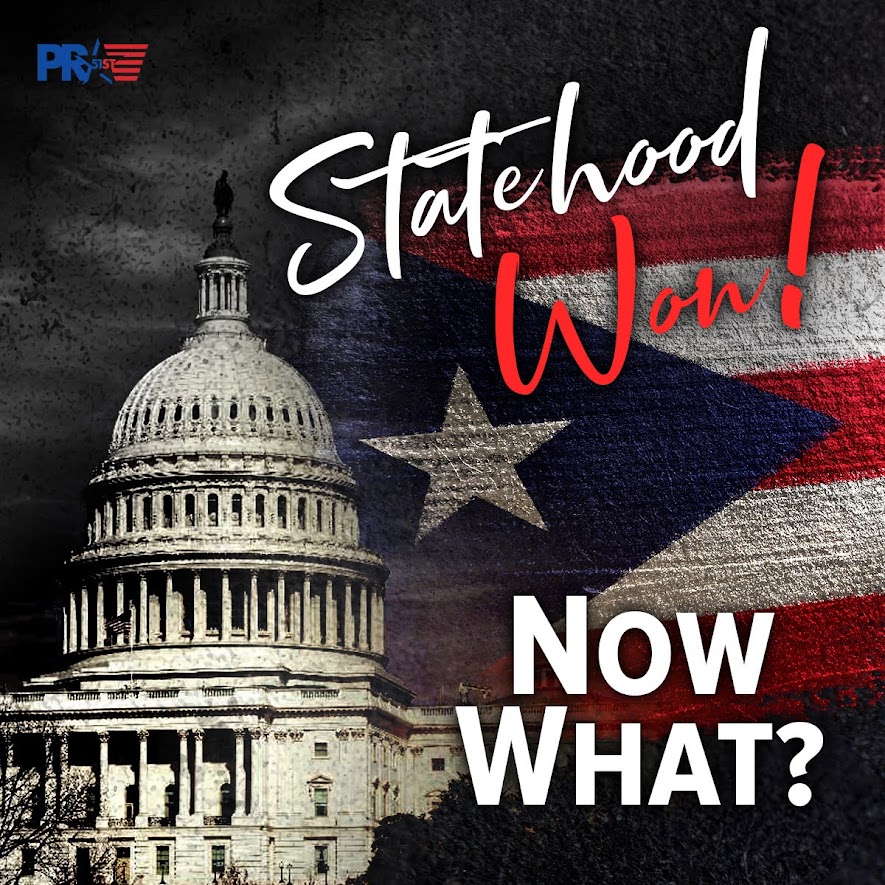
Here we are, a year after the most recent status vote. Statehood has won four times — in every referendum held in this century.
What stands in the way of statehood for Puerto Rico? Under the U.S. Constitution, only Congress can make new states. Earlier this year, separatists created a hoax suggesting that President Trump was considering an executive order forcing independence on Puerto Rico. In fact, the President of the United States cannot change a territory’s status. Only Congress can do this.
The current Congress is not considering statehood — or independence, for that matter — for Puerto Rico. The current Congress has passed only 90 bills so far, including disapproval of a number of rules from the Environmental Protection Agency and several name changes, such as a bill “To name the Department of Veterans Affairs community-based outpatient clinic in Toms River, New Jersey, the Leonard G. ‘Bud’ Lomell, VA Clinic.” They are in the midst of a government shutdown and face a variety of crises at home and abroad.
Acknowledging the relatively light legislative output thus far, it’s important to recognize that the current political landscape presents a uniquely challenging environment for major consensus building. With razor-thin majorities and deeply entrenched partisan divides across both chambers and the White House, achieving significant, sweeping accomplishments often requires an extraordinary level of cross-aisle cooperation that has proven difficult to secure in these polarized times. Statehood for Puerto Rico has support from both Democratic and Republican legislators. Indeed, both major national party platforms have committed to support statehood at various times. But the current political climate makes it unlikely that Puerto Rico will rise to the top of legislators’ priority lists.
What can we do?
We can continue holding status votes. It is clear that statehood will continue winning. The majority of Puerto Ricans, as well as the majority of Americans living in the states, want statehood for Puerto Rico. It is only a matter of time before Puerto Rico becomes a state.
Between now and then, we can prepare a path for statehood. Tax reform can get Puerto Rico’s tax code in order so that the transition to statehood can be accomplished with little upheaval. Licensure and other regulations can be brought in line with state regulations. Infrastructure upgrades can be undertaken so that the wave of investors who will follow statehood can build businesses in Puerto Rico with confidence. Support for small businesses and entrepreneurs can prepare businesses on the Island to benefit from the level playing field that statehood will bring.
Which party will be in power in the federal government when Puerto Rico is admitted as a state? That will be the party that gets the glory of adding another star to the flag. Who will be president at that time? That’s the individual who can claim a new state as part of his or her legacy. Puerto Rico needs to be ready for statehood when it is accomplished.
No responses yet