

The news is currently full of conversations about changing the political status of territories and even countries against the will of the residents. Is it legal to do that? A territory or nation’s political status can certainly be changed, but can a political status be forced on people? The answer to the question is a firm, “It depends.”
Could Congress force independence on Puerto Rico?
Rep. Tom McClintock said on Facebook that he is working with independence groups to draft a bill which would, he says, “advance the conversation” on independence. That’s not much of a statement, but he did actually say that he is in favor of independence for Puerto Rico, even though the voters on the Island have said repeatedly that they don’t want it. The statement suggests that Rep. McClintock doesn’t know what “self-determination” means, but it does speak in favor of independence.
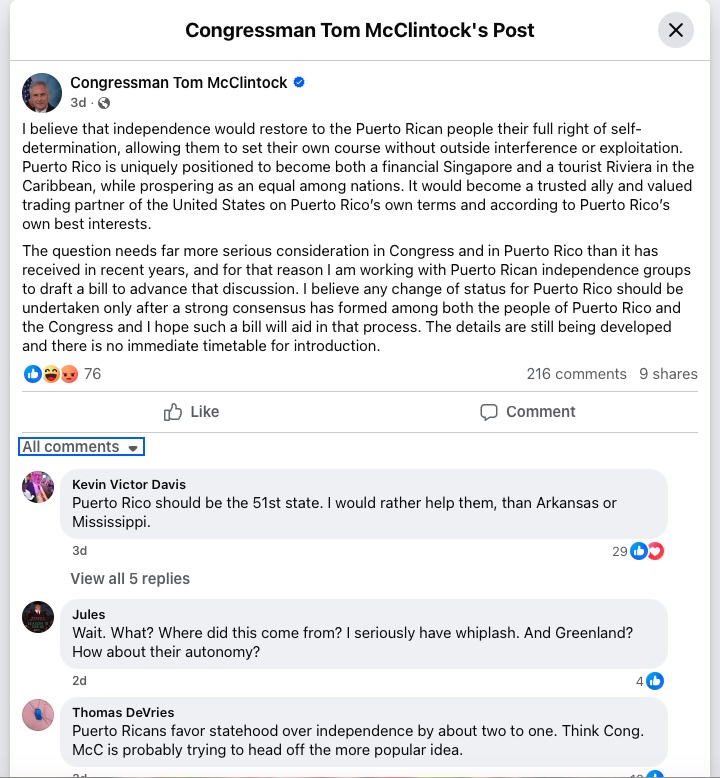
Making a Facebook post is not equivalent to introducing a bill, and quite a few independence bills have been introduced in Congress in the past without gaining support from Puerto Rico or from Congress. Nor is McClintock suggesting that Congress should force independence on the unwilling people of Puerto Rico. But could they?
The answer to that is yes. Under the terms of the Constitution, Congress can decide to cut off Puerto Rico and force the territory to become independent. They can also give Puerto Rico to some other country, just as Spain gave Puerto Rico to the United States.
Can Congress force statehood on a territory?
The answer to this question is less clear. The Constitution says that a new state cannot be made with land from an existing state without legislative approval from the state being altered, so there is some limit on the ability of Congress to admit states.
However, Congress has admitted states in the past without holding a referendum first. Alabama, Illinois, and Indiana were all admitted without a plebiscite. The elected leaders petitioned for statehood and Congress admitted them. However, there is clear evidence that the voters wanted statehood. For example, Alabama’s counties elected representatives to a constitutional convention with the express purpose of creating a state constitution. There is no case in which a territory was admitted against the will of the people.
And these were all U.S. territories. The U.S. Constitution makes it very clear that Congress can admit U.S. territories with a simple majority vote. There is no suggestion that territories belonging to other nations, such as Greenland, could be admitted to statehood by Congress.
Can Congress admit another country as a state?
This is also a yes. Texas, Vermont, and perhaps also California were independent nations when they asked for statehood and were admitted. Hawaii was the Republic of Hawaii, under President Sanford Dole, when their government asked to become a U.S. territory. If Canada wanted to become a state, Congress could vote to admit them.
However, annexing another country or even part of another country is not legal.
This used to be done frequently. For example, Spain claimed Puerto Rico just by landing a representative and saying they claimed it. Vikings from Iceland did the same with Greenland. Taking a country by right of conquest was also popular in the far-distant past. Spain, for example, overthrew the Aztec Empire and the United States took quite a bit of land from Mexico with the Mexican-American War.
After World War II, however, Article 2(4) of the UN Charter forbade any “threat or use of force” against other countries. Oxford Public International Law points out that the Monroe Doctrine was specifically intended to halt conquest in the Western Hemisphere, and throughout the 20th century, international law repeatedly emphasized that national borders can no longer be changed through conquest or force of any kind.
Greenland could not, therefore, be admitted as a U.S. state against their will or against the will of the Kingdom of Denmark without violating international law. International law also supports the Stimson Doctrine, presented by U.S. Secretary of State Henry Stimson in 1932. Stimson said that if one nation invades or annexes another, other nations in the world do not need to recognize their claims. We see this in the case of Ukraine, the Japanese claim to the Philippines, and many more examples.
Statehood for Puerto Rico
Congress could admit Puerto Rico as a state at any time, legally, and with full authority under the U.S. Constitution. Puerto Rico is a U.S. territory, there are no border disputes, and the people of Puerto Rico have expressed their desire for statehood in four status votes. This would be a good time to remind your congressperson of these facts.
No responses yet