The political parties of Puerto Rico, USA, are not the same as the political parties in the states. The mainland is divided between the Republican and Democratic parties, but Puerto Rico has a different political landscape.
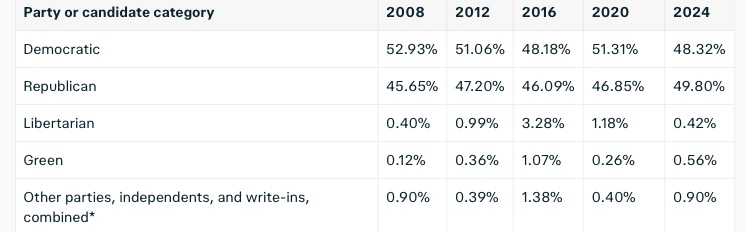
In U.S. presidential elections, it’s clear that the two main parties are the only real contenders. Democratic and Republican candidates get roughly half the vote, with the Democrats usually receiving the majority of the popular vote during the 21st century. Other parties have not reached 5% during this century. Remember, the U.S. doesn’t elect presidents directly, but through the Electoral College. Here, we are just looking at the people’s votes.
Status-based parties
Traditionally, Puerto Rico has had three political parties corresponding to the three possible options for political status: territory, state, or independent nation. However, if you look at a chart for Puerto Rico’s governors’ races just like the one for U.S. presidents’ races, you see a very similar pattern. The statehood party typically gets the largest number of votes (there was one exception, just as in the states). The “commonwealth” party got fewer votes, but it was still a clear two-party system, just as in the states — until 2020.
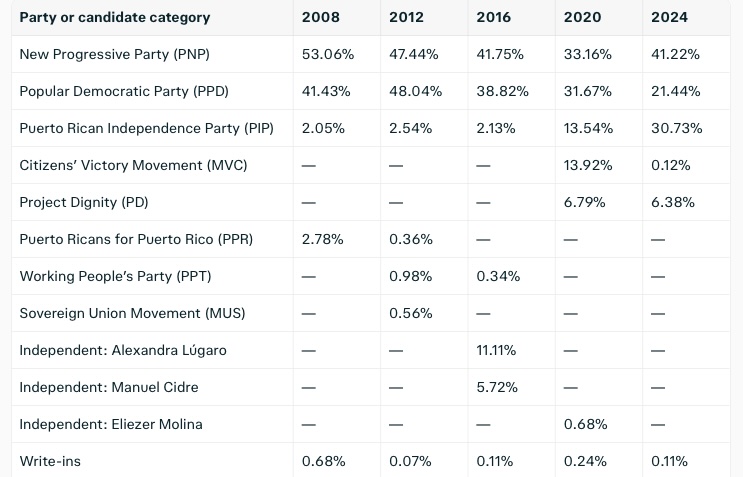
Just looking at the numbers, we would have to say that the U.S. presidential elections are between the Democrats and the Republicans, with the Democrats generally ahead. We’d also have to say that the Puerto Rico gubernatorial elections are between the PNP (statehood) and the PPD (commonwealth), with statehood generally ahead.
The PNP and the PPD both had governors in office. The Independence Party was not much more significant than the Libertarian Party in the states. But Puerto Rico had some smaller parties that got more votes than the Libertarian or Green parties.
Puerto Rico’s new order
In 2020, however, new parties entered on the scene. MVC and Project Dignity arose in 2020 and both got more votes than the Independence Party ever had. In the same year, the Independence Party finally broke into double digits. Both major parties lost voters to the smaller parties.
In 2024, the MVC and the Independence Party made a deal. Both their supporters voted for the Independence Party candidate. On their own, neither candidate could threaten the two-party system. Together, however, they were able to outflank the “commonwealth” party, which came in third pace for the first time. Statehood still won, with a higher margin than usual, but the “commonwealth” party slipped.
The Independence Party, which had hovered around 2%, took a leap in 2020 and hit double digits for the first time. In 2024, they clubbed together with the MVC and brought their total above 30%.
The MVC still had a handful of votes in 2024 and Project Dignity didn’t make any headway, but the older small parties dropped out entirely.
The “commonwealth” party did much worse than usual in the 2024 governor’s race, but they got their candidate into the resident commissioner position. Puerto Rico still is essentially a two-party system, but the smaller parties have more force than in the states. As the “commonwealth myth” has been discredited by Supreme Court decisions and federal statements, Puerto Rico voters are waking up to the reality: commonwealth just means territory. Some members of the “commonwealth” party have shifted to supporting free association — which they then define just as they had been defining “enhanced commonwealth.”
The continuing dominance of the statehood party, along with the statehood majority votes in every status vote this century, make it clear that statehood is Puerto Rico’s choice. Calls for self-determination which ignore the Island’s repeated acts of democratic self-determination are either deceptive or deluded.
No responses yet