

“Puerto Rico Must Deal With Its Corruption Circus Before Statehood Can Be Considered,” reads a headline at the Daily Caller. “Before serious debate can begin,” the author continues, ignoring the century plus of serious debate that has already taken place, “the island’s leaders must address the perception that corruption there has run amok.”
“Perception” is the right word. We wrote about this before, noting that Puerto Rico was not actually more corrupt than states. There was in fact a perception that Puerto Rico has trouble with corruption, even though the facts didn’t bear it out. But have things changed since the last time we looked at the evidence? And, more importantly, is corruption actually a reason not to discuss statehood?
Is Puerto Rico especially corrupt?
Let’s begin by looking at federal convictions for corruption. If we begin there, we can see that Puerto Rico is pretty high up on the list. The largest malefactor is Washington, D.C., which has 3.49 convictions per 100,000 people according to the Cato Institute. The Virgin Islands is next with 2.14 per 100,000, followed by Guam and the Northern Marianas, which share 1.56 per 100,000 residents. Puerto Rico clocks in with just 0.9 per 100,000.
1: District of Columbia 3.49
2: Virgin Islands 2.14
3: Guam and NM 1.56
4: Louisiana, Eastern (New Orleans) 1.29
5: Puerto Rico 0.90
American Samoa is not on the list, but we have to notice that territories come ahead of all states but one. One of the main reasons is that territories don’t have the resources to take care of their own corruption cases, so they are far more likely to have federal convictions. Even so, Louisiana is ahead of Puerto Rico with 1.29 convictions per 100,000. The rest of the states, like Puerto Rico, have fewer than 1 conviction per 100,000 residents.
We can also see that the perception of control of corruption in Puerto Rico — the degree to which people think the government has a handle on corruption — is lower for Puerto Rico than for the United States.
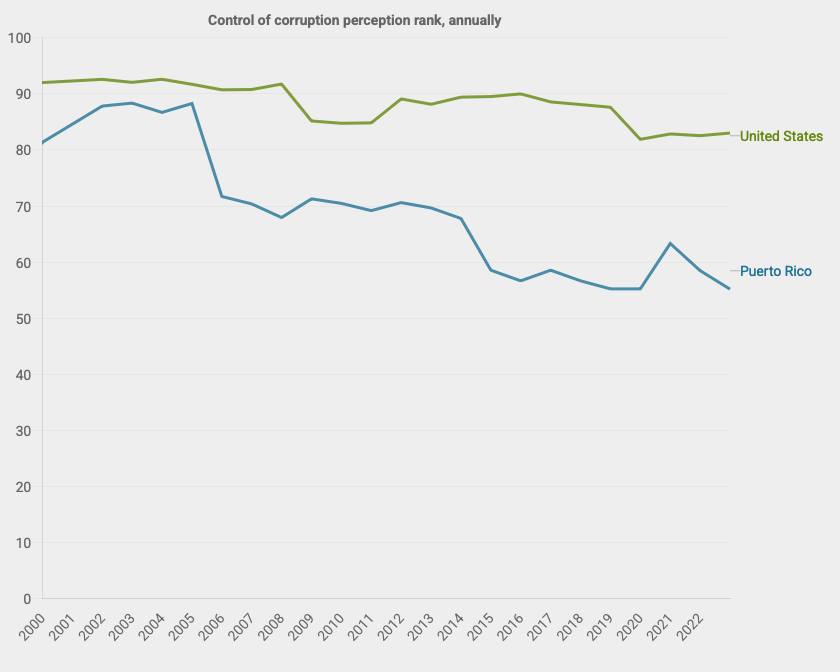
But perception is not always reality. For example, the majority of Americans believe that President Trump is corrupt, according to a recent YouGov poll. Yet Trump has not been convicted of corruption. Neither perceptions of corruption nor convictions for corruption put Puerto Rico consistently ahead of states, but the stereotype lingers.
One thing is certain: Puerto Rico has put into place a number of anti-corruption measures, suggesting that the territory is trying to combat corruption and the perception of corruption.
Statehood is a cure for corruption
A desire for law and oder is one of the major reasons territories have had in the past for seeking statehood. Sometimes that desire focused on war, guerrilla fighting, or violent outlaws. In Oklahoma and Hawaii, a desire for local control and equal application of the rule of law was key. But often it was about corruption in the government. Let’s look at a few cases.
Arkansas, for example, is right in the middle of the Cato Institute list of states ranked by level of corruption. Yet Arkansas was, before statehood, one of the most blatantly corrupt territories. The Governor of the Missouri Territory put his five sons into positions of political power in Arkansas Territory, and “the Family,” as they were known, controlled Arkansas politics through violence and corruption. Statehood cleaned it up.
Kansas was famous for voter fraud. In their case, votes for and against slavery were cast by members of both pro-slavery and anti-slavery groups who snuck into the territory and voted. One election had 6,307 votes cast in favor of the pro-slavery candidate when the entire population of eligible voters in Kansas was only 2,905.
Colorado‘s “Denver Ring” was infamous for cronyism, nepotism, and outright embezzlement. The territorial government was openly corrupt at a time when the national government as well often made headlines for corruption scandals. Yet Colorado is 47th in Cato’s ranking today, with just 0.11 convictions per 100,000.
Accountability
With less support from the federal government, inadequate resources, and limited representation in Washington, territories may be more vulnerable to corruption than states. Without the full protection of the U.S. Constitution and equality with the states, territories may be subject to colonial pressures. There is little clear evidence that Puerto Rico has higher levels of corruption than the states, but if it does, statehood would be — for Puerto Rico as it was for other territories in the past — the solution to the problem.
No responses yet