

Statehood will provide full representation in the federal government, equal rights with all other states, guaranteed U.S. citizenship, the full protection of the U.S. Constitution, and the ability to vote in presidential elections. But will it make a difference to your wallet?
Income
Workers in Puerto Rico currently earn an average of $18.62 per hour. That’s a significant increase over the past decade, even though it is only about half the average in the states.
At the same time, unemployment has fallen. Again, the difference from 10 years ago is significant, even though it’s higher than in the states.
These charts from the Federal Reserve show gradual improvement for Puerto Rico’s workers, but the numbers continue to compare unfavorably with the states.
Does statehood make a difference?
A Facebook comment said, “Puerto Rico holds a privilege no other place under the U.S. flag has: its residents don’t pay federal income tax on locally earned income. That exemption is not a loophole — it’s the foundation of Puerto Rico’s economic independence and the single greatest advantage the island has over every U.S. state.” Puerto Rico has more people living in poverty than any state. More than half the children on the Island live in poverty. If Puerto Rico’s income tax exemption were actually an advantage over every U.S. state, Puerto Rico would not be trailing every state economically.
In reality, the federal income tax exemption was given to Puerto Rico specifically so that Puerto Rico could levy high taxes on its people. Washington figured Puerto Ricans couldn’t afford both federal and local taxes, so they exempted Puerto Rico from some — not all — federal taxes. Puerto Rico has the highest sales taxes in the nation, property taxes right in the middle of the national range, and higher income taxes (except for people with loopholes).
Every territory that has been admitted as a state became more prosperous. Hawaii, the 49th state, saw an enormous economic boom, and wages increased at an annual rate of 4%. In the chart above, we can see that Puerto Rico’s average wage took 6 good years to increase by 4%. An increase of 4% each year would be a very different proposition. With a level playing field and equal participation in American democracy, Puerto Rico could expect to be in a much better economic position. The government of the state of Puerto Rico would no longer need punishing local taxes or destructive tax tricks.
What’s more, with reliable infrastructure equal to that in the states, daily life would be much different. It would be easier to get to work, easier to grow a business, and easier to live economically. Right now, the cost of living includes lack of reliable water and electricity plus the fact that 85% of food and nearly all energy fuel must be imported.
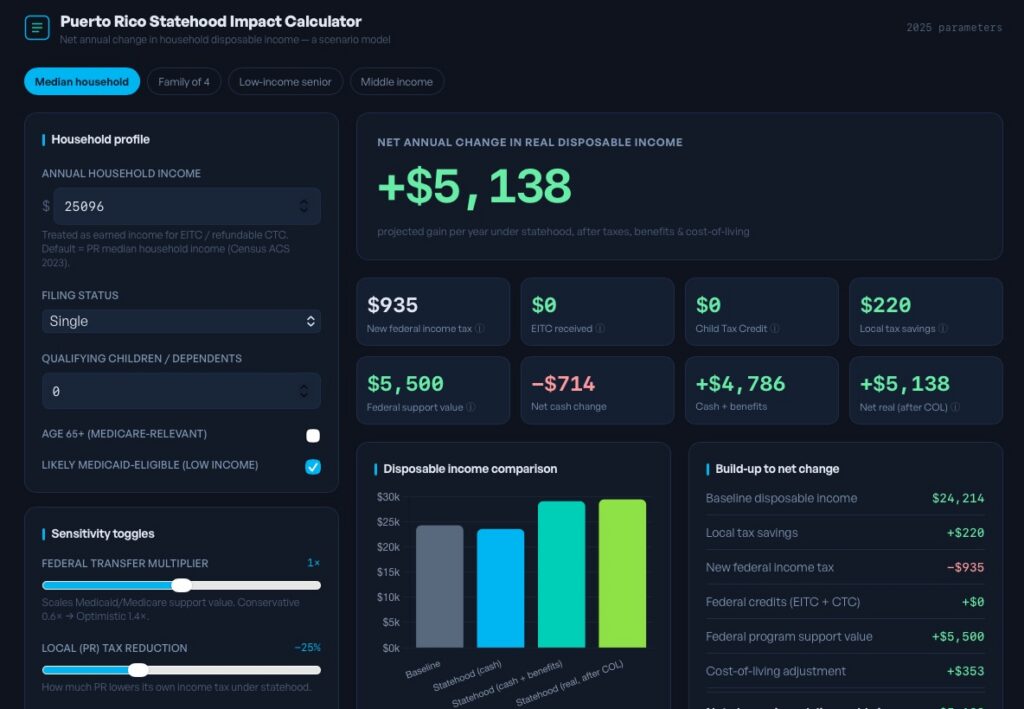
Try the calculator
Here’s an example showing the difference statehood would make for a single person earning the average per capita income in Puerto Rico: an extra $5,138 per year. Try the calculator for yourself. The results are an estimate based on publicly available economic data and can’t be precisely accurate.
Still, history shows that statehood always leads to greater prosperity for territories. There is no reason to think that Puerto Rico would be different. It’s just one more reason to reach out to your congressperson and let them know you want statehood.
No responses yet