

Hurricane Maria made landfall in Puerto Rico on September 20, 2017, as a high-end Category 4 storm, the strongest to hit Puerto Rico in nearly a century. Its 155 mph winds and torrential rain caused widespread and immediate destruction. The island’s entire electrical grid, which was already old and poorly maintained, was completely destroyed, leaving all 3.4 million residents without power. This was the start of the longest blackout in U.S. history, with some residents remaining without electricity for almost a year.
Communication networks, roads, and bridges were also crippled, isolating entire communities, particularly in the mountainous, rural regions. This made it nearly impossible to distribute aid. It was challenging for residents to access essential services like food, clean water, and medicine. Hospitals, lacking power and supplies, were forced to operate on generators, putting critically ill patients at high risk. The lack of clean water led to public health concerns, and the difficulty of travel hampered rescue and recovery efforts for months.
The death toll controversy
One of the most important and tragic aspects of Hurricane Maria’s devastation was the controversy surrounding the death toll. The initial official count released by the Puerto Rican government was 64, a number that included only those who were directly killed by the storm and had Hurricane Maria listed on their death certificates. Investigative journalists and public health researchers soon found that the true number was much higher, as many deaths were not directly caused by the storm itself, but by its catastrophic aftermath.
In August 2018, nearly a year after the storm, the Puerto Rican government commissioned a study by George Washington University. This study revised the official death toll to 2,975. This number accounted for “excess deaths”—people who died from causes related to the hurricane’s aftermath, such as a lack of access to medical care, electricity for life-saving equipment, or clean water. This tragic discrepancy highlighted the failure of official disaster protocols to account for indirect fatalities and underscored the systemic challenges of responding to a major humanitarian crisis.
Long-term consequences
The impact of Hurricane Maria went far beyond the immediate physical damage. The storm devastated Puerto Rico’s already struggling economy, with an estimated $90 billion in damages, nearly matching the island’s entire annual GDP. The agricultural sector was hit especially hard, with an estimated 80% of crop value lost. This further strained the food supply on an island that already imported about 85% of its food.
The slow and often-criticized federal response to the disaster, coupled with the ongoing economic crisis, led to a mass exodus of residents. Hundreds of thousands of Puerto Ricans were displaced, with many moving to the U.S. mainland. This population decline has had a lasting effect on the island’s social and economic fabric, as it lost a significant portion of its workforce and tax base. The hurricane and its aftermath also exposed deep-seated issues related to Puerto Rico’s political status as a U.S. territory, highlighting its lack of representation and control over its own recovery efforts. The legacy of Hurricane Maria continues to shape the island’s challenges and its long-term recovery.
Still, the devastation of Hurricane Maria did bring awareness of Puerto Rico to the majority of Americans. Directly after the storm, many people in the states were asking, “Why are we helping Puerto Rico when there are Americans in need of help?” The shocking truth was that most Americans on the mainland did not even know that Puerto Ricans were U.S. citizens by birth.
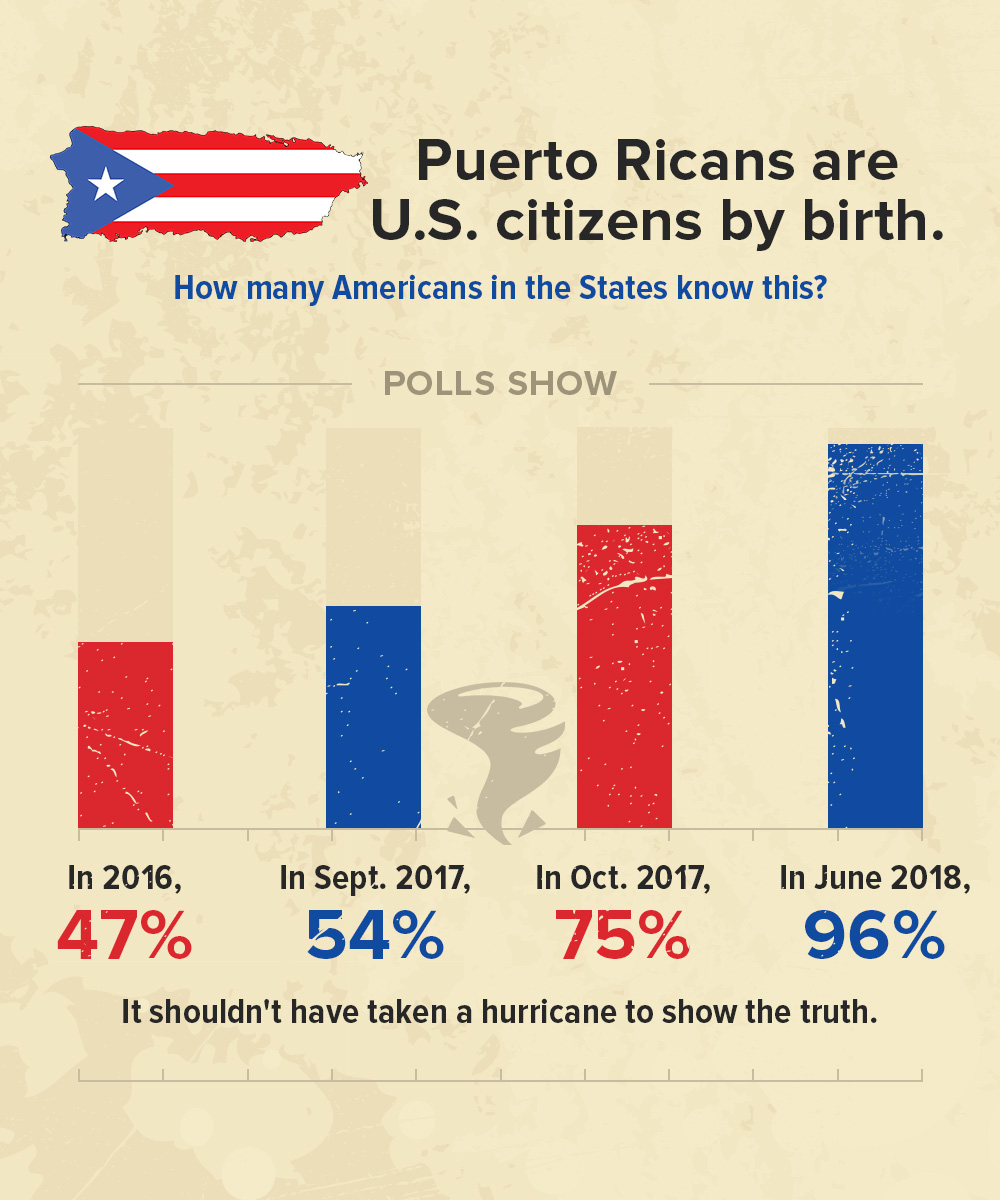
Many didn’t realize that Puerto Rico belonged to the United States, or that the territory was working to become a state. The hurricane and the news coverage of the terrible storm and its even more terrible aftermath brought Puerto Rico to the attention of people living in the states.
There is still a great deal of ignorance about Puerto Rico in the states, and even in Congress. Reach out to your representatives and make sure they know that Puerto Rico is a territory of the United States ready for the rights and responsibilities of statehood.
No responses yet