
A new report at FierceBiotech.com makes some important points about Puerto Rico’s role in American biotech, and thus in the U.S. healthcare system in general. The report, prepared by Invest Puerto Rico, begins with reminders of the current power of Puerto Rico in the biotech field.
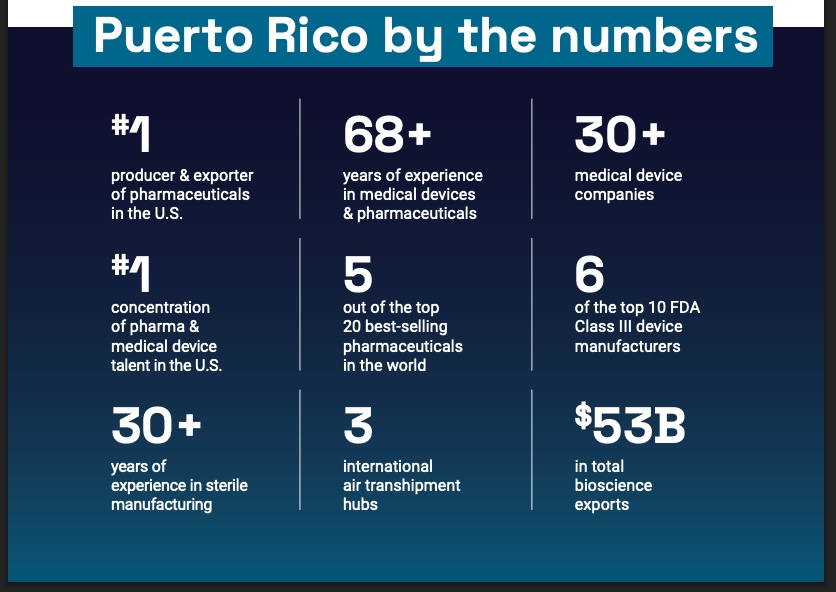
Puerto Rico has for many years been the top U.S. exporter of pharmaceuticals, including a large proportion of top-selling drugs. It’s also a top exporter of biomedical devices, and has a high concentration of FDA-approved facilities, experienced medical industry workers, and experts in biotechnology. For the United States, Puerto Rico is a highly valuable property in this industry.
Not only are there important assets worth investing in, but the capacity to produce medications in the United States can be a game-changer for medical supply chains. World events can disrupt supply chains, as we all learned during the pandemic, and the United States relies heavily on China and India for pharmaceuticals — particularly for generic drugs, which are hard to produce profitably in the states.
Not just supply chains
The federal government and industry insiders have been talking about trying to reshore healthcare products since the pandemic. Puerto Rico is obviously a major opportunity. The presence of a large, qualified, bilingual workforce is a key factor that makes this possible. The report points out that currently employed specialists in the field number three times the national average. Puerto Rico also has a lower proportion of people in the workforce, meaning that there are people available to work as well as experienced workers able to train them. With manufacturing in the states facing severe labor shortages, this is a big plus for Puerto Rico.
Puerto Rico also has strong credentials in research. The science talent in the territory, combine with the special geographic advantages of the Island, has already made Puerto Rico a key player in agricultural research, allowing stateside researchers to complete their work faster and more efficiently. And since Puerto Rico operates under FDA and other U.S. regulations, safety isn’t an issue. This strengthens the U.S. as a biopharma innovation ecosystem, not just a manufacturing base.
Reducing costs
Invest Puerto Rico also reports something we’re less pleased to see: the average annual wage for bioscience workers in Puerto Rico, $57,000, is a real bargain compared with states. North Carolina salaries are double that average, and in Massachusetts the average annual wage in the field is $203,000. Still, with an average household income of $26,297, Puerto Rico can use those higher-paying jobs. Pharmaceutical companies can lower their costs while increasing prosperity in Puerto Rico, and we hope the wages will rise over time.
This is an important point. Right now, Puerto Rico’s biochemists, engineers, and technicians can easily increase their incomes by moving to a state. Providing more, better paid jobs can help people from Puerto Rico stay in Puerto Rico rather than feeling forced to leave by economic inequity. This, along with increased manufacturing and tax reform, will provide a stronger tax base for the Island.
Still, increased efficiency for R&D, shorter supply chains, and less dependence on foreign manufacturing can help reduce healthcare costs. Puerto Rico is currently home to biosimilar drug developments which are expected to improve access to currently costly drugs in the future.
Obstacles
What are the obstacles to a flourishing of biotech in Puerto Rico? The territory looks like an obvious centerpiece for U.S. medical strategy going forward. But there are problems.
Infrastructure is one. While pharmaceutical companies currently operating on the Island are experienced with responding to natural disasters and electrical grid uncertainty, a stronger infrastructure future and better logistics capacity will make Puerto Rico much more appealing to biotech companies from the mainland and abroad.
Political instability is another. Puerto Rico has voted for statehood four times and demanded admission from Congress, but is still an unincorporated territory. That means that it could become an independent nation, which would be hugely risky for biotech companies operating there. It could also continue as an unincorporated territory, with all the problems that entails.
Current tax breaks are presented as a draw by the Invest Puerto Rico report, but they also are another source of instability. For one thing, they change frequently and sometimes without much notice. For another, they encourage companies to wash profits through Puerto Rico while spending money on construction, workers, and infrastructure in the states, where they can benefit from tax deductions from their expenditures. The system increases risk for investors and reduces the benefits to Puerto Rico.
Would statehood help?
Yes, it would. As a state, Puerto Rico would have greater stability, thus reducing the risk for companies considering a move to the Island. It would have opportunities to improve infrastructure and to invest in the workforce training pipeline.
It’s time for Congress to recognize that Puerto Rico is already a key player in the U.S. biotech ecosystem, with the capacity to do much more. Admitting Puerto Rico as a state would enrich U.S. capacity, benefit Puerto Rico enormously, and improve the troubled U.S. healthcare system. Contact your legislators now and point out that statehood for Puerto Rico is a key improvement in an area that is top of mind for U.S. voters across the nation.


No responses yet