

The United States is a democracy, but we are also a republic. That means that we do not vote directly for laws. Instead, we vote for representatives, who go to Congress as our legislators and make laws. Their constituents can write to them, call them, or visit them to share their views on issues. The representatives are not required to vote just as their voters say, but they can be influenced by people who voted for them and who may do so again in the future.
We also do not vote directly for the President of the United States. Instead, each state has a number of electors, depending on the state’s population. Residents of the state vote for their chosen presidential candidate, and the electors take the state’s majority position to the Electoral College. They vote, in most cases, as the state voted. Since Puerto Rico is a territory of the United States, not a state, we do not participate in the Electoral College at all.
Does Puerto Rico have representatives?
Puerto Rico has a resident commissioner, but this person cannot vote on laws — even on laws specifically about Puerto Rico. When a vote to admit Puerto Rico as a state comes to the floor of Congress, Puerto Rico’s representative will not be able to vote on the question.
The resident commissioner can introduce legislation and vote in committees, and sometimes is allowed a symbolic vote. However, if his or her vote would make a difference in the outcome, that vote is excluded. Essentially, the resident commissioner has no vote.
Puerto Rico has no senators at all.
So Puerto Rico does have a representative, but does not have full representation. Once Puerto Rico becomes a state, the Island will have about four Members of the House and two senators.
Who speaks for Puerto Rico in Congress?
Because Puerto Rico doesn’t have the kind of representation that states have, the territory has to rely on representatives from the states. Puerto Ricans in Congress, such as Nydia Velazquez, Ritchie Torres, and Darren Soto, regularly speak up for the Island. So do representatives from territories that have become states more recently, such as Alaska’s Don Young and Lisa Murkowski. They remembered what it was like to be a territory.
There are also many legislators who recognize the need for equal rights in Puerto Rico without having any personal connection with the Island.
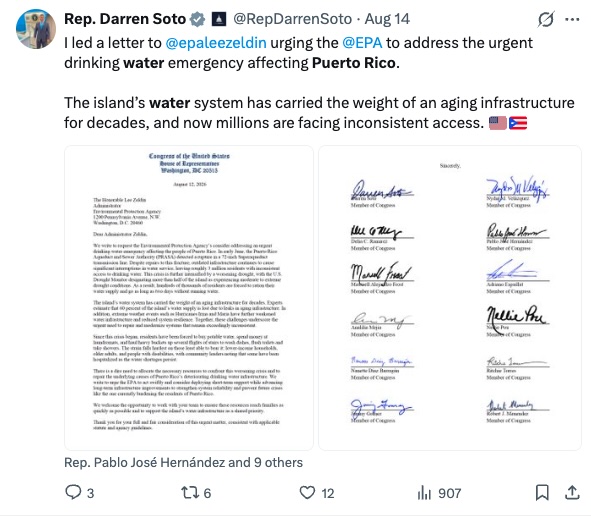
With the recent water crisis in Puerto Rico, a number of Senators and Members of the House of Representatives have spoken for Puerto Rico.
Rep. Darren Soto of Florida worked with 11 other members of the House to send a letter to the Environmental Protection Agency requesting action to help Puerto Rico.
Members of both the House and Senate, including Rep. Jared Huffman of California, Rep.Bennie Thompson of Mississippi, and Senator Martin Heinrich of New Mexico, wrote to the Government Accountability Office asking for an investigation of Puerto Rico’s water system and a briefing on the causes of the water crisis and how the federal government was helping to solve the problem.
Rep. Hernandez signed on to both the letters. He also asked Governor Gonzalez-Colon to request a federal emergency declaration, which would allow more funding and support for the Island.
Reps Alexandria Ocasio-Cortez and Nydia Velazquez, both of New York, published a joint statement demanding action on the crisis. “As Puerto Ricans continue to ration water, almost $30 billion in federal disaster grant assistance sits in limbo waiting to be disbursed,” they wrote. “The Governor and the federal government must ensure that these funds are unlocked and distributed immediately.”
They continued, “FEMA has also continued the cruel policy of forcing Puerto Rico to pay for infrastructure repairs in advance and seek reimbursement later. In the midst of a crisis, FEMA must reverse course and expedite the advanced disbursement of funds to fortify the island’s water system.”
Congressional Hispanic Caucus Chair Rep. Adriano Espaillat and Rep. Velázquez also made a joint statement, saying “We must hold accountable those in the federal and local government who have slowed, delayed, or undermined the resources needed to rebuild and strengthen the island. Puerto Rico and the rest of Caribbean islands face growing challenges from climate change, including the increased risk of drought conditions associated with El Niño and catastrophic hurricanes—-which mount pressure on already strained water and energy systems. These realities underscore the urgent need for resilient infrastructure and sustained investment to ensure communities can withstand future crises.”
You can speak up, too
As we have seen, legislators from California to Florida and New Mexico to New York speak for Puerto Rico. If you live in a state, you can reach out to your representatives and ask them to speak up for Puerto Rico, too. Without a full voice in American democracy, Puerto Rico must rely on allies in the states to get the representation we need.
No responses yet