

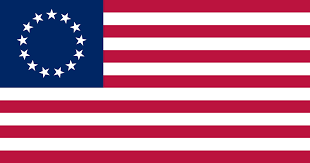
Flag Day falls on June 14th each year. It was on June 14th, 1777, that the U.S. Congress approved the design of the first national U.S. flag. It is often referred to as the Betsy Ross flag in honor of the seamstress who made it. It was probably designed by Francis Hopkinson, who also designed the Great Seal of the United States.
This is what Congress wrote: “Resolved, that the Flag of the thirteen United States shall be thirteen stripes, alternate red and white; that the Union be thirteen stars, white on a blue field, representing a new constellation.”
States and cities celebrated Flag Day with parades and community events, but it was not until 1916, the year before Puerto Rico achieved U.S. citizenship, that President Woodrow Wilson proclaimed June 14th a national Flag Day observance. In 1949, Congress established the day as a national observance — not a federal holiday — and called on Presidents of the United States to make a proclamation each year.
The U.S. flag
The various colonies and various armies used a wide range of different flags. One of the earliest to be adopted by different groups was the Grand Union or the Continental Colors. This flag had the red and white stripes as in the Betsy Ross flag, but had the British Union Jack in the corner. When the colonies determined to choose independence, this flag became too British, and was no longer used. The Stars and Stripes have been used continuously since 1777, but there have been twenty-seven different versions of the flag in terms of the number of Stars and Stripes.
In 1818, after two more stars had been added to the flag, Congress decided to continue adding a new star for each state admitted, but not to increase the number of stripes, since that was already becoming impractical. They went back to the 13 stripes we still use today.
Since states have often been admitted in groups, more than one star was added to the flag at one time. However, Congress didn’t say any more than “stars, white on a blue field,” different flag makers arranged the stars in different patterns until 1912. In that year, President Taft standardized the flag. The stars have remained in regular rows ever since, even though the number of stars has increased.
51 stars
When Puerto Rico is admitted as a state, the flag will need 51 stars. If D.C. also becomes a state, it will need 52. It is easy with modern technology to fit 51 or 52 stars into the constellation on the flag.
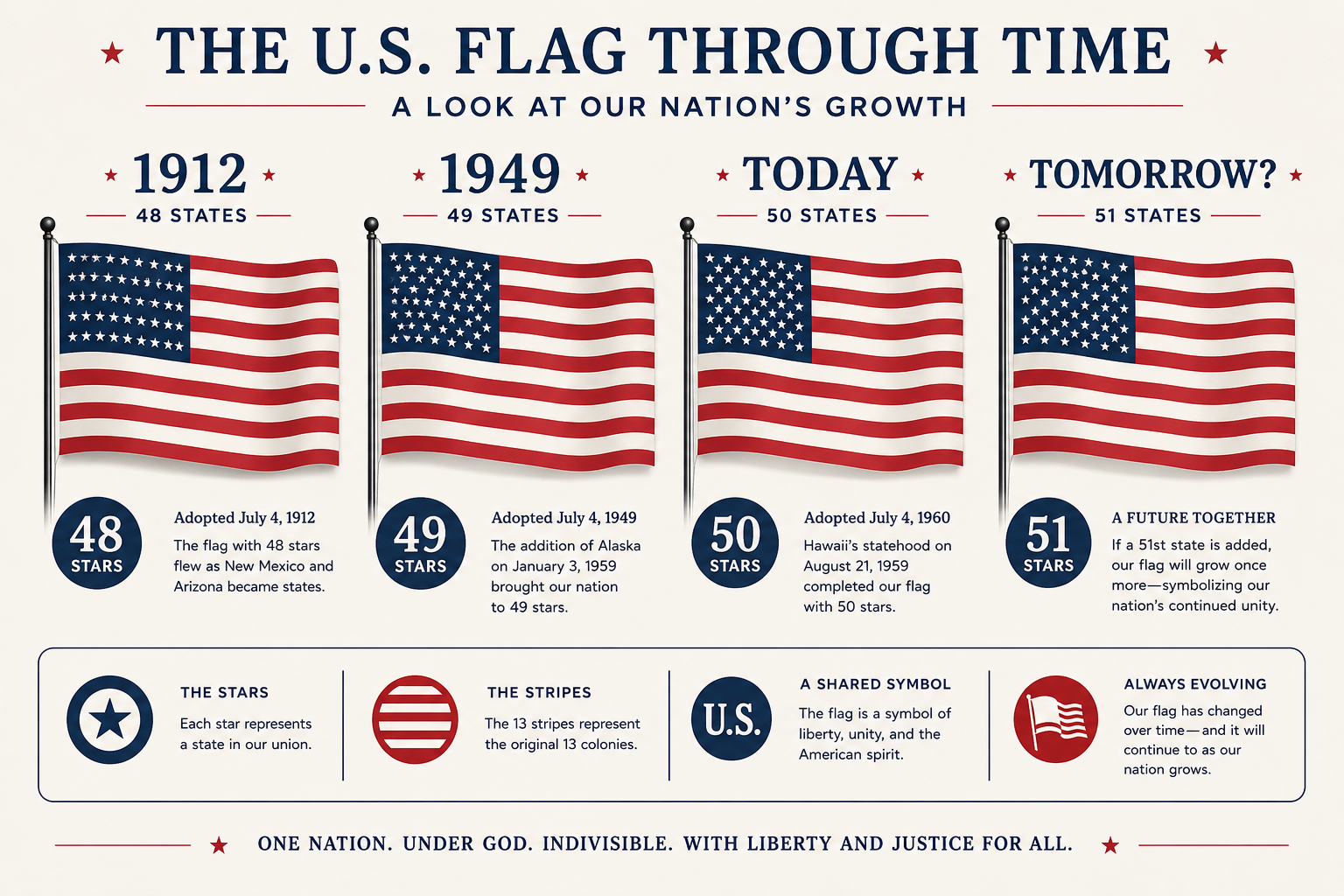
Adding more stars to the flag will be a moment of pride for our nation, as it has been in the past. What a fitting way to celebrate the 250th birthday of the United States! Let your congressional representatives know that you feel that way.

No responses yet