
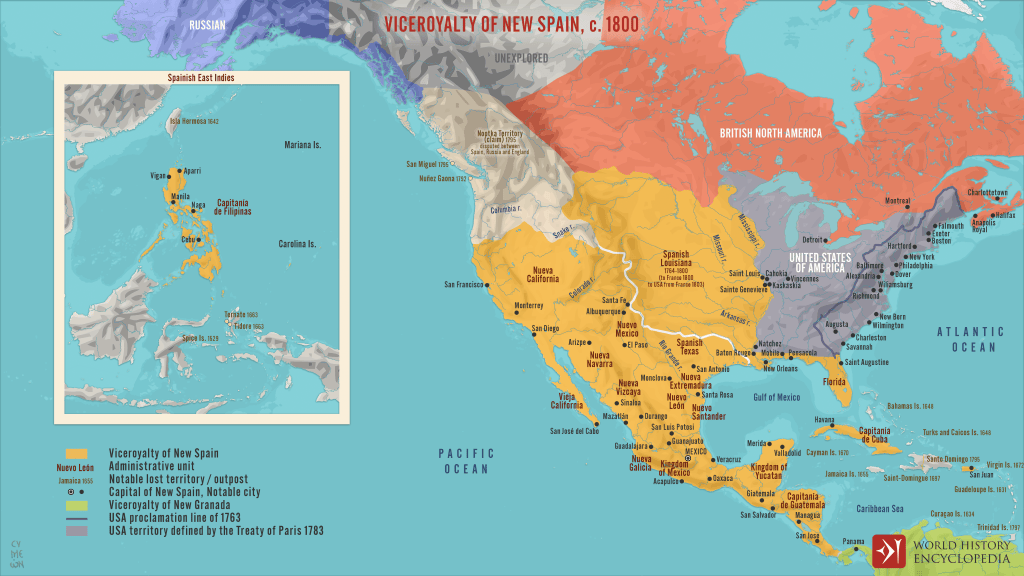
Costa Rica, El Salvador, Guatemala, Honduras, and Nicaragua all celebrate their independence from Spain on September 15th, and September 15th in the United States is the beginning of National Hispanic Heritage Month. New Spain, the New World possessions of Spain, comprised a large part of North America in 1800, as the map below shows. Spanish is the second most popular language spoken in the United States, and more than 20% of people in the U.S. — some 68 million — consider themselves Hispanic or Latino. The importance of Hispanic heritage in the United States cannot be denied.
Yet most stateside students do not learn about Puerto Rico, which is a territory of the United States and home to more than 3 million U.S. citizens, 98% of whom are Hispanic. Why not?
Puerto Rico is not in the state standards
Thanks to the 10th amendment, each state makes its own decisions about education in the public schools. When Puerto Rico is a state, the state and local governments will make the decisions about things like the language taught in the schools, the subjects covered, and so on.
Most states, including states with large Puerto Rican populations, do not require any knowledge about Puerto Rico. Even when students learn about the 50 states, usually in third grade, the territories are not included.
Later, in junior high or high school, Puerto Rico is offered as a possible example by several states.
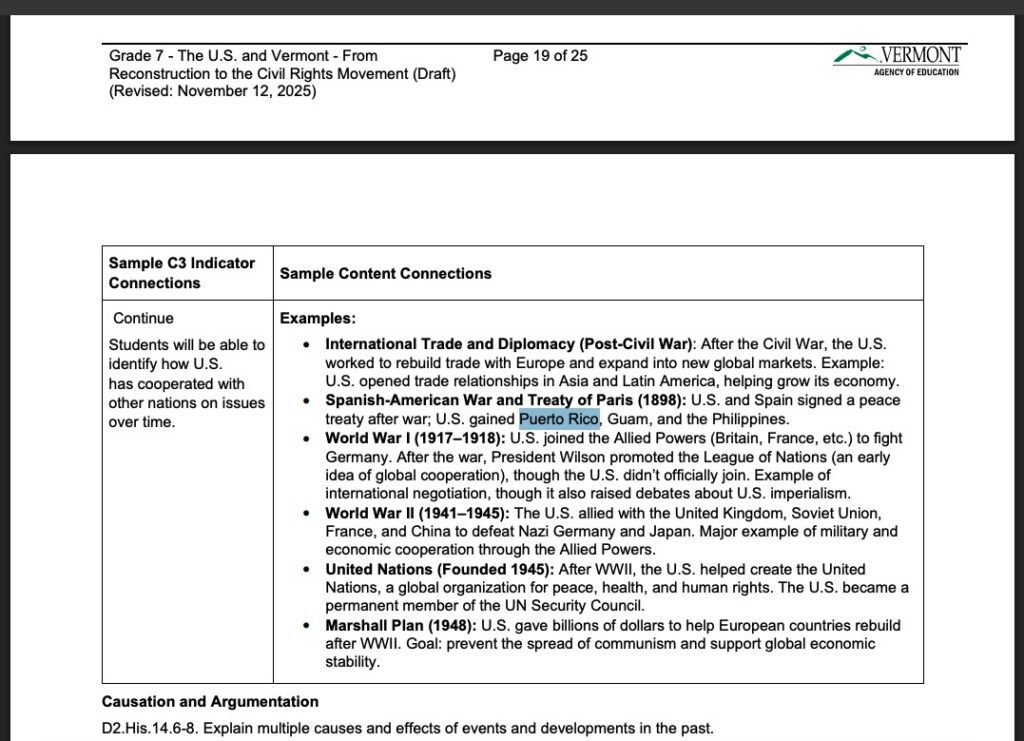
7th graders in Vermont can learn about Puerto Rico as an example of “how U.S. has cooperated with other nations on issues” in the Treaty of Paris. This was the treaty between Spain and the United States in which Spain ceded Puerto Rico to the United States.
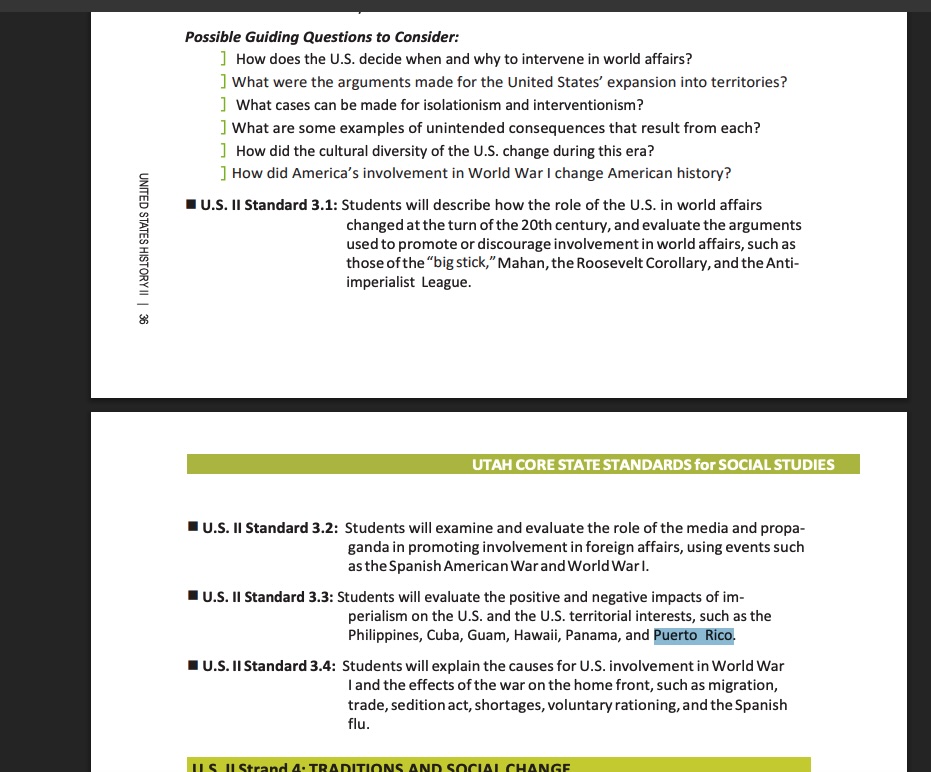
Utah students learning about U.S. involvement in global affairs “will evaluate the positive and negative impacts of imperialism on the U.S. and the U.S. territorial interests, such as…Puerto Rico.”
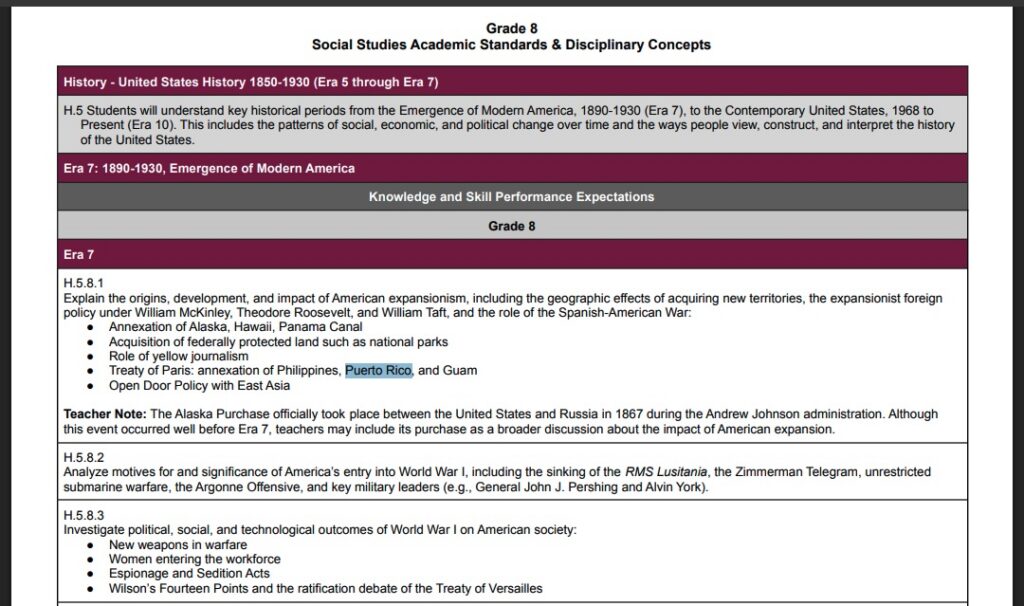
In Arkansas, teachers can use Puerto Rico as an example to “explain the origins, development, and impact of American expansionism.”
Michiganders
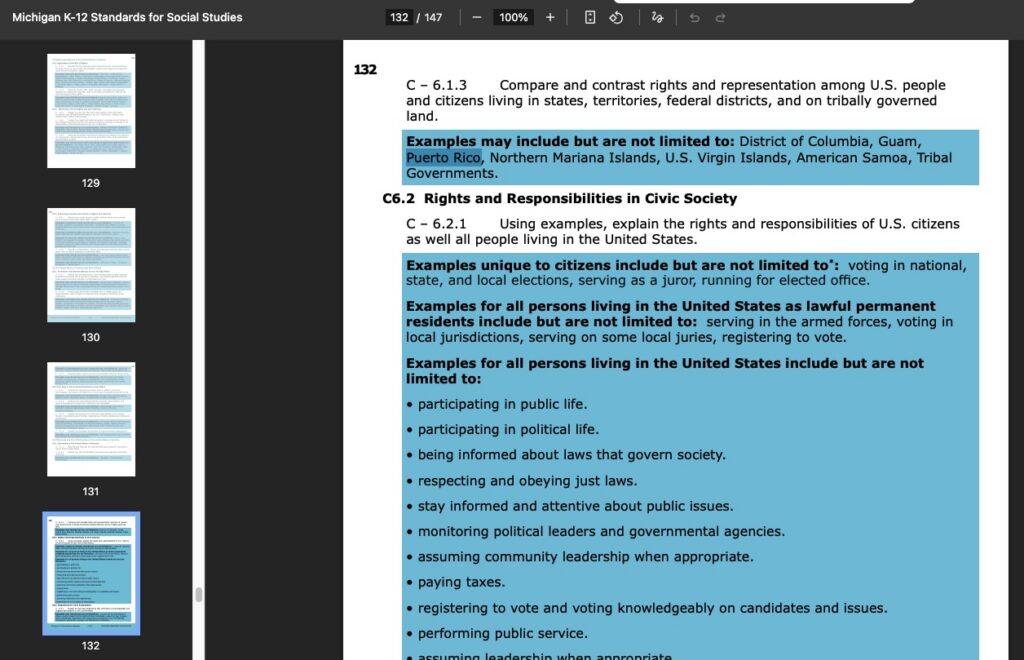
Michiganders are invited to “compare and contrast rights and representation among U.S. people and citizens living in states, territories, federal districts, and on tribally governed land.” The standards go on to say that “examples may include but are not limited to” D.C. tribal governments, and the five inhabited U.S. territories.
Note that there is no mention of Puerto Rican culture. You could Celebrate Hispanic Heritage Month in your classroom with a lesson on the advantages of imperialism, but it’s not going to be a popular choice.
Florida, New York, Pennsylvania, and other states with large Puerto Rican populations do not mention Puerto Rico in their state social studies standards. However, curriculum decisions can be made in counties, cities, school districts, and individual classrooms, so teachers in these areas may be teaching about Puerto Rico.
Puerto Rico is not in the textbooks
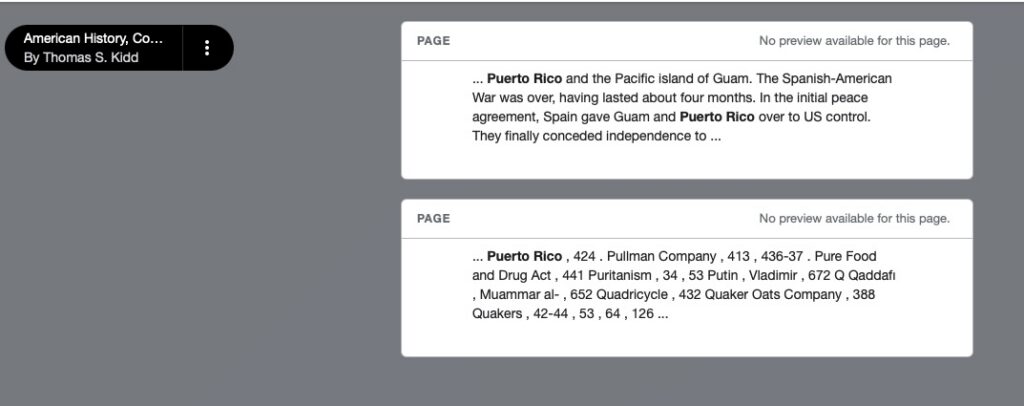
There are many different history and social studies textbooks in use in different schools and classrooms. The image above shows what we have seen in history textbooks in general: Puerto Rico is mentioned along with the other territories of New Spain which Spain gave or sold to the United States. Puerto Rico is mentioned on one page; the Pullman Company shows up on three pages. This gives a typical indication of the level of importance of Puerto Rico in American history texts used in the states.
Again, this is not likely to lead to substantive lessons on Puerto Rico culture and heritage.
But what about Hispanic Heritage Month?
We have found that Puerto Rico is included in online Hispanic Heritage Month resource lists more often now than when we first started tracking this. In the list from HispanicHeritageMonth.gov, shown below, we can see a lesson called “BackStory: After Hurricane Maria—The History of Puerto Rico and the Unites States.” The link didn’t work, but we found an archived page from the defunct podcast “Backstory” with that title.
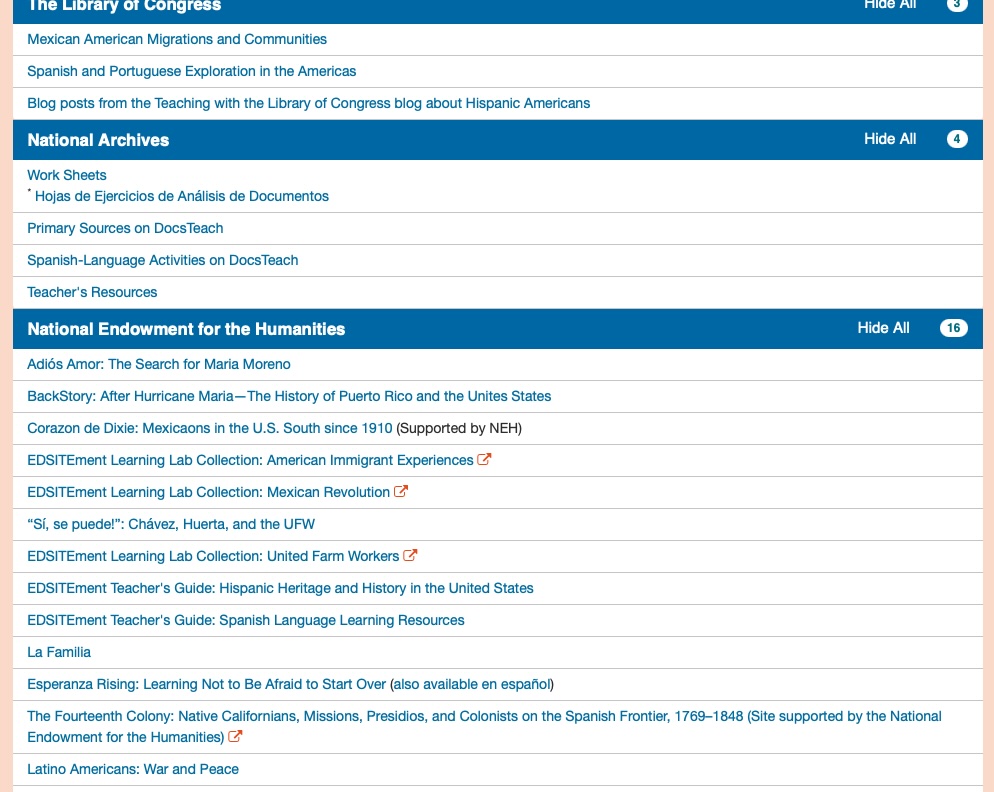
In some ways, it’s a perfect example: it focuses on Hurricane Maria, the event that caused millions of Americans to learn that Puerto Rico is a U.S. territory, it’s a single resource in a lengthy list, and it’s not kept up to date. The focus of the list is actually on Mexico.
This is because 57.3% of Hispanic Americans are of Mexican heritage. Including residents of Puerto Rico and of the states, Puerto Ricans make up just 9% of the U.S. Hispanic population. Mexicans are the largest group and Puerto Ricans are the second largest group, so it seems reasonable to make papel picado to celebrate Hispanic Heritage Month.
But emphasizing Mexico not only encourages the idea that all Hispanic Americans are alike — and Mexican — but also ignores one very special thing about Puerto Rico. Puerto Rico, after all, is part of the United States. People born in Puerto Rico are U.S. citizens by birthright. We have a representative in Congress (though he can’t vote) and can vote in presidential parties (though not in presidential elections). Mexico is certainly an important Spanish-speaking country, and several of our states used to be part of Mexico.
When should Puerto Rico be studied in the states?
Here are some times we’d suggest stateside schools learn about Puerto Rico:
- In third grade lessons about the 50 states and D.C., include Puerto Rico and the rest of the inhabited territories.
- When studying the Revolutionary War, Civil War, World Wars, Korean War, and more recent conflicts, don’t leave out Puerto Rico’s servicemen and -women.
- In discussions of migration within the United States, as when Dust Bowl-era Oklahomans migrated en masse to California, include Puerto Rican migrants to the Northeastern states.
- When learning about the three branches of government, include Supreme Court Justice Sonia Sotomayor and Puerto Rican legislators like Jose Serrano and Darren Soto.
- When studying the space program, don’t miss the large numbers of astronauts and other NASA professionals from Puerto Rico — not to mention the Arecibo Observatory.
We could keep going, but the point should be clear: certainly, Puerto Rico should be part of Hispanic Heritage Month celebrations, but the Island should also be part of everyday history and social studies lessons.
If you are a teacher, a student, a parent with kids in school, or a citizen who cares about eduction, you should care about this. And we can’t overlook this fact: voters can push Congress to take action at last on Puerto Rico statehood, and voters who don’t understand Puerto Rico’s place in the United States can’t be expected to help much. Let’s bring up more informed voters. Speak to your school, your kids’ school, your school board, or your legislators.
No responses yet