
The photo above shows the seemingly ghostly soldiers of the Korean War Memorial in Washington, D.C. The art installation recalls the Korean War, a conflict between North and South Korea on one level, but on another level it was part of the Cold War between the United States and the Soviet Union.
The outline of the war
Korea was divided after World War II, with the Soviet Union occupying the north and establishing a communist government. The United States supported a democratic government in the south. Both sides wanted to reunify Korea under their chosen political and economic system, and there were skirmishes along the border for several years.
In 1950, North Korea invaded South Korea, with the help of the Soviet Union and later Communist China. The United Nations called on members to support South Korea, and the United States took the lead. The war went on for three years, until an armistice — but not a peace treaty — was signed in 1953. By that time, 5 million had died, the division of Korea was permanent, and the Soviet Union and the United States were deep in a Cold War.
An armistice is a cease-fire, and no peace treaty was ever signed, so North and South Korea are still technically at war.
Puerto Rico in the Korean War
Puerto Rican soldiers were central to the Korean War, with an estimated 61,000 serving in the U.S. Army, many as members of the famed 65th Infantry Regiment, the Borinqueneers.
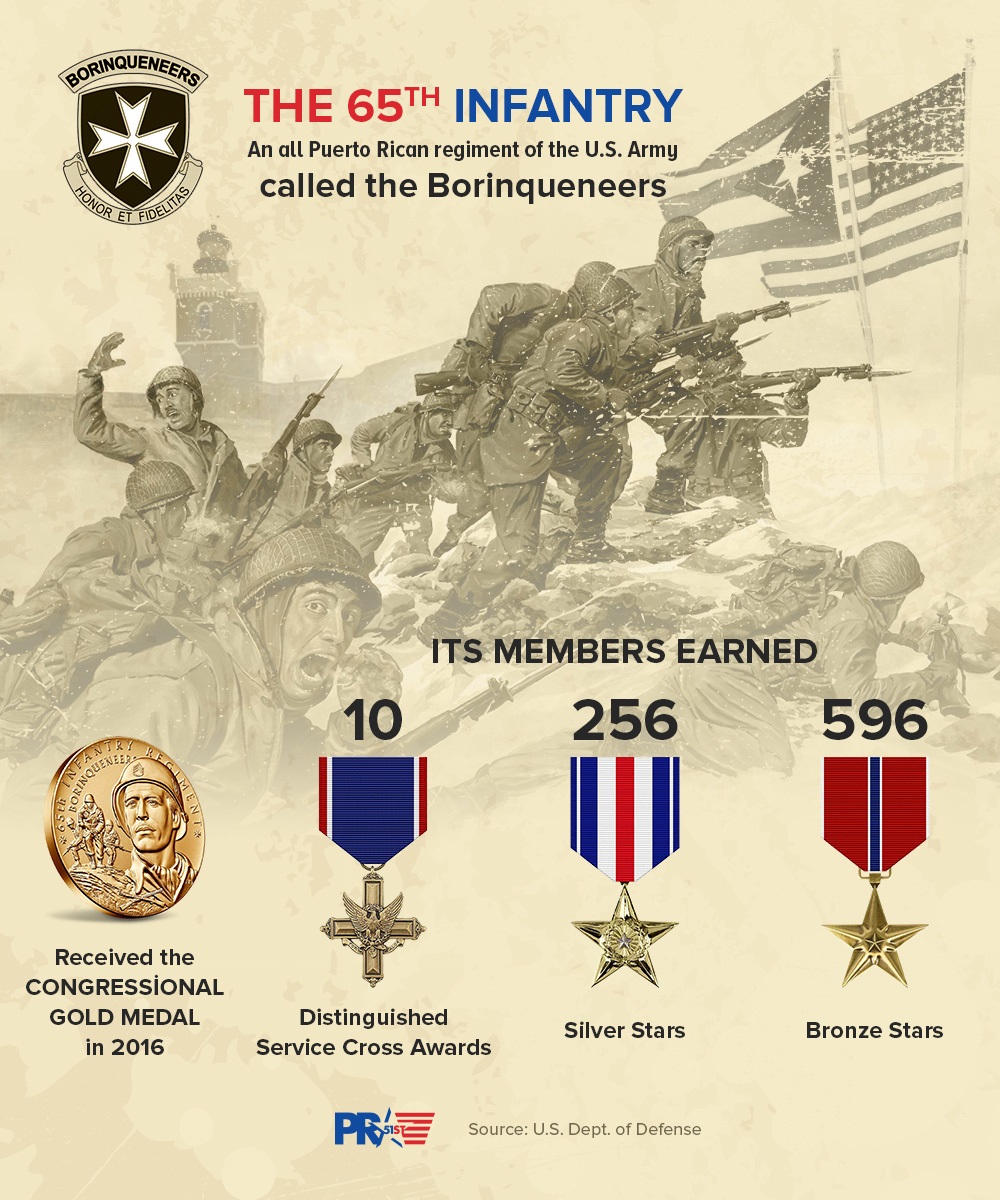
Despite the regiment being the U.S. military’s last segregated unit, these volunteer soldiers displayed immense valor. The Borinqueneers executed the last fixed-bayonet charge in U.S. Army history and played a critical role in the withdrawal from the Chosin Reservoir.
Sadly, their service came at a high cost, with hundreds killed and over 120 listed as Missing in Action. Many Puerto Rican veterans experienced brutal combat conditions. They also faced discrimination, including language barriers and unfair treatment from some officers, which even led to the controversial mass court-martial of 95 men in 1952 (though their sentences were later overturned).
Ultimately, their dedication—fighting for a nation that did not fully grant them equality—became a defining moment, earning the regiment the Congressional Gold Medal in 2016 and cementing a legacy of sacrifice and pride for the Island.
Puerto Rico in the Cold War
Puerto Rico continued to be involved in the Cold War, standing against Cuba, which was supported by the Soviet Union, in the two superpowers’ efforts to prove that their system was the best. Puerto Rico’s rapid development and economic strength was displayed by the United States as proof of the superiority of the democratic system over the communist system of the Soviet Union.
The collapse of the Soviet Union left Cuba in a severe ecpnpmyic and social crisis.
However, there is some irony in the idea of Puerto Rico as a beacon showing the superiority of democracy. Puerto Rico continues to send sons and daughters into the U.S. armed forces — there have been over 375,000 Puerto Rican veterans — but they still cannot vote for their Commander in Chief.
Statehood for Puerto Rico
Statehood for Puerto Rico is a good idea for many reasons, but the military record of the Island is plenty to demonstrate that Puerto Rico deserves statehood. There are more than three million patriotic U.S. citizens living in Puerto Rico, the majority have voted for statehood repeatedly, and it is way past time that the territory should be admitted as a state.
This Veterans Day, remind your legislators that admitting Puerto Rico as a state is the right thing to do.
No responses yet