

Puerto Rico is a territory of the United States. That means that it is land belonging to the United States, which is not a state. If you live in a state that used to be a territory (there are 32 of them), you might have heard about “territory days” in school, in a state history class. Colorado celebrates Territory Days every year in May. If you think about territories at all, it might be something out of the Old West. Unless you’re from Alaska or Hawaii, in which case you or your parents or grandparents probably remember living in a territory. So what is territorial status?
What is territorial status?
The United States consists of 50 states, the District of Columbia, five inhabited territories, and a bunch of uninhabited territories. Broadly speaking, a territory is just a piece of land the nation owns but which is not yet a state.
Living in a territory means that, while you might be a U.S. citizen by birth, you can’t vote in presidential elections, you have very limited representation in Congress, and Congress is allowed to treat you differently from states. If you live in an unincorporated territory — and that includes all the inhabited territories — then the U.S. Constitution doesn’t apply to you fully. You must follow the laws in the Constitution, but you are not automatically protected by the rights laid out in that important document.
This is not an ideal political status.
One of the U.S. territories, Puerto Rico, has repeatedly voted against continuing to have territorial status and for statehood. Puerto Rico has repeatedly requested statehood from Congress. This means that the current relationship between Puerto Rico and the United States is government without consent of the governed.
The Declaration of Independence includes these words: “We hold these truths to be self-evident, that all men are created equal, that they are endowed by their Creator with certain unalienable Rights, that among these are Life, Liberty and the pursuit of Happiness.–That to secure these rights, Governments are instituted among Men, deriving their just powers from the consent of the governed.”
In the case of Puerto Rico, territorial status has been rejected by the majority of voters many times. This political status is therefore government without the consent of the governed. As we near the 250th anniversary of the Declaration of Independence, we should feel shame that we continue to hold an unwilling territory. This is not just a problem for Puerto Rico. It is a problem for all Americans who value the foundational principles of our nation.
How can a territory become a state?
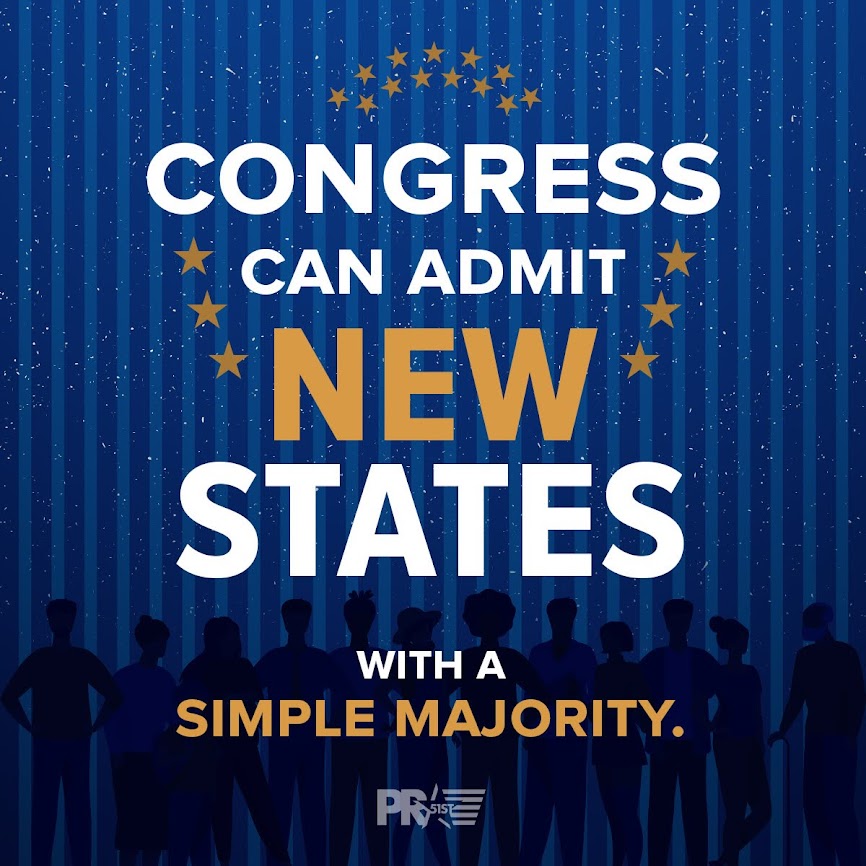
Congress can admit a state with a simple majority.
In practice, every state that used to be a territory struggled to become a state. There were many obstacles. Some of the territories were involved in wars. Some didn’t have enough residents yet. Some had laws that conflicted with federal laws.
Puerto Rico has none of these problems. Congress has abdicated the responsibility to resolve Puerto Rico’s status issue by admitting Puerto Rico as a state. Adding the 51st state to the Union would be a perfect way to observe the nation’s 250th birthday.

Reach out to your congressman and senators. Let them know that you care about Puerto Rico and want to see justice done.
No responses yet