

Recent headlines have brought out a twist on political campaigning for the upcoming 2026 midterm elections: instead of working to change people’s political party alliances, what about just redistricting states to give additional members of Congress to one party or the other? Texas, with President Trump’s encouragement, has redrawn district borders with a view to adding 5 Republican members of Congress. California is fighting back by redistricting to push 5 Democratic members into Congress. It’s tit for tat — but “When does it stop?” as California’s Senator Tony Strickland asked. He worries that the United States could end up with “chaos” if states take up redistricting ahead of elections every two years.
Here’s a thought: instead of gerrymandering, why not add Puerto Rico as a state, gaining as many as six new representatives in the House and Senate, with a good chance at even numbers in each party?
How does redistricting work?
In theory, redistricting is done every 10 years or so to make sure that each voting district has an equal number of voters. That way, if many new people have moved into a particular district, their votes will not be less valuable than an older, more settled district that now has fewer voters than the growing district. Under the Voting Rights Act of 1965, the redistricting can’t be done with an intention to dilute the voting power of minority voters.
Sometimes, however, redistricting is actually gerrymandering. Gerrymandering is the practice of manipulating the boundaries of electoral districts to create an unfair political advantage for a particular party or group. It is a highly controversial and often illegal process that can significantly impact the outcome of elections.
The term “gerrymandering” was coined in 1812 by a Boston newspaper. It was a portmanteau of the name of then-Massachusetts Governor Elbridge Gerry and the word “salamander.” The term was created after Gerry signed a bill that created a bizarrely shaped state Senate district, which critics said resembled a salamander.
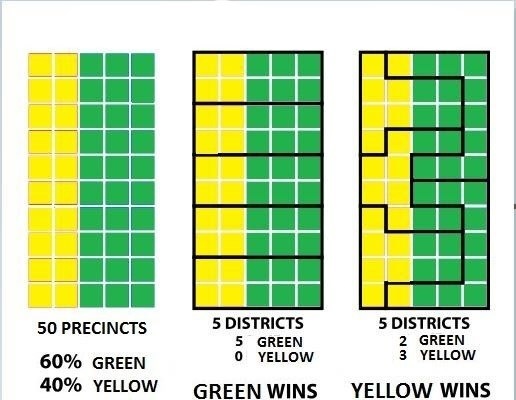
The chart below shows a simplified example of how gerrymandering can work.
North Carolina districts in the maps below show some of the strange shapes a district can take when the goal is to favor one party over another:

Two common tactics in gerrymandering:
- Cracking: Splitting a strong group of voters (e.g., a political party’s base) into multiple districts to make them a minority in each one.
- Packing: Concentrating a large group of voters into a single district, so they win that district by a huge margin, but their influence is reduced in surrounding districts.
Both Texas and California are unashamedly using this strategy in an effort to influence the upcoming elections.
What about adding states?
Obviously, gerrymandering has been around for a long time, but quite a few states were added right before presidential elections in an effort to bring in new electoral votes on one side or the other. For example, Arkansas and Michigan were admitted in 1836 and 1837 respectively, to support the Democratic Party. North Dakota, South Dakota, Montana, and Washington were admitted as a group in 1889 to support the Republican candidate.
So there is definitely precedent for using this method.
Adding Puerto Rico would have the advantage of bringing in a likely purple state, encouraging Puerto Rican voters in swing states to vote for whichever party was able to take credit for Puerto Rico’s admission, and giving the sitting president the important legacy of adding another star to the Star-Spangled Banner. At the same time, it would reduce the tension being created by the current redistricting fever.
Suggest this solution to your congressional representatives.
No responses yet