

Greenland has been in the headlines a lot recently, and in social media, too. One thing we’re hearing and seeing in conversations about Greenland is confusion on territory status. It makes sense that Americans would be confused about territories. It’s been almost 70 years since Congress admitted a territory as a state. At that time, it had been almost 60 years since the previous admission of a territory as a state. The average American thinks of territories as some kind of ancient history. But Greenland and Denmark have refused statehood, so talk has turned to Greenland as a territory or a free associated state — another thing the average American finds confusing.
Here’s just one example:
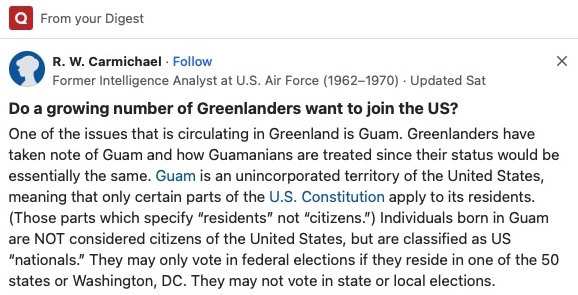
The author says that “Greenlanders have taken note of Guam and how Guamanians are treated since their status would be essentially the same. Guam is an unincorporated territory of the United States, meaning that only certain parts of the U.S. Constitution apply to its residents. (Those parts which specify ‘residents’ not ‘citizens.’) Individuals born in Guam are NOT considered citizens of the United States, but are classified as US ‘nationals.’ They may only vote in federal elections if they reside in one of the 50 states or Washington, DC. They may not vote in state or local elections.”
This writer has some knowledge about territories, but look at all the factual errors:
- It’s true that the U.S. Constiotution doesn’t apply fully in unincorporated territories, but it has nothing to do with the words “residents” or “citizens.”
- Guam has birthright citizenship, just as Puerto Rico does. It is the citizens of American Samoa who are nationals rather than citizens.
- Guamanians can vote in federal elections if they live in a state, just like Puerto Ricans. They can also vote in state and local electiins if they live in a state, and in their local and territory elections if they live in Guam. Just like Puerto Ricans.
The discussion after this post included corrections of these errors, but also more confusion.
“I presume the situation is similar for the Virgin Islands,” said one commenter. “Puerto Rico, where my parents came from, is treated better.” Actually, Puerto Rico is in the same legal position as Guam: both are unincorporated territories of the United States, with U.S. citizen populations who can’t vote in presidential elections.
What does this tell us?
Conversations like this — which can be found all over the web — tell us that even though people use the word “territory” correctly in talking about Greenland, they may not really understand it. That suggests people recognize the word from news about Puerto Rico, Guam, and other territories, but often don’t connect it to concrete ideas like lack of voting representation in Congress or limited sovereignty. They’re not sure whether Greenlanders are Danish citizens or Puerto Ricans are U.S. citizens.
One of the effects of this confusion is that stateside voters don’t understand why Puerto Rico’s political status matters. Americans care about justice, as we can see from the outpouring of support for Greenland. They understand that Greenland doesn’t want to be a territory of the United States, and support that desire.
Puerto Rico also doesn’t want to be a territory of the United States. Voters on the Island have said four times in status votes that they want statehood. Continued territory status is no longer on plebiscite ballots, but the last time it was, in 2017, it got less than 2% of the vote. The United States is built on central principles like government by consent of the governed, and Puerto Rico is no longer willing to be a U.S. territory. Congress must take action to admit Puerto Rico as a state. Tell your legislators so.
No responses yet