

Resident Commissioner Paul Jose Hernandez sent a “Dear Colleague” letter to his fellow Members of Congress announcing the Equality and Statehood Summit and offering “context…which may help you and your staff in potential engagements with participants in this summit.”
The fantasy section
Hernandez began with a quick history lesson: Puerto Rico became a territory of the United States in 1898 and Puerto Ricans gained U.S. citizenship in 1917. He goes on to say that Puerto Rico “became a commonwealth” in 1952, ignoring the fact that the federal government said repeatedly during and since the name change to “Commonwealth of Puerto Rico” that the political status of Puerto Rico had not changed at all. One example of this is the Supreme Court decision in 1980 in Harris v. Rosario, but there are many, many examples.
Hernandez went on to explain that political parties in Puerto Rico are divided according to status: “whether Puerto Rico should become. state, remain a commonwealth with enhanced autonomy, or become independent.” Once again, the resident commissioner ignores the fact that “remain a commonwealth” means “remain an unincorporated territory” with only a fantasy of “enhanced autonomy.”
The lie
Hernandez next claimed that “Support for statehood dropped from 52% in 2020 to 49% in 2024.” He was speaking of the status votes in 2020 and 2024.
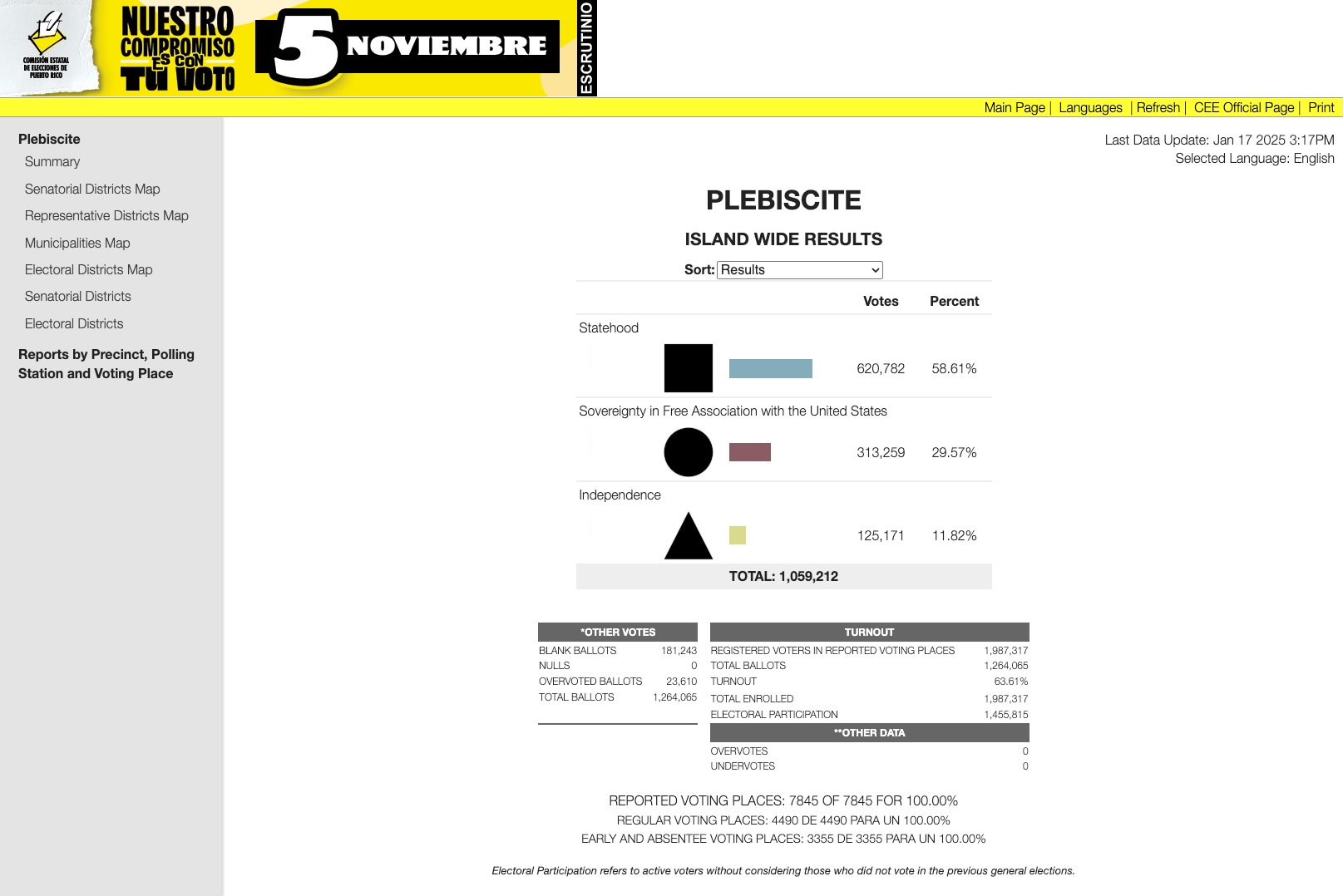
This screenshot from the official election results site shows that statehood actually received 58.61% of the vote in 2024. That would round up to 59% — not 49%.
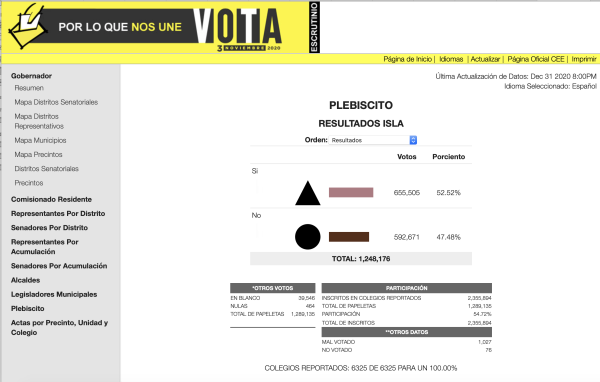
As for the 2020 vote, statehood received 52.52% of the vote, which rounds up to 53%, not down to 52%. So if we rephrase Hernandez’s line to use the accurate numbers, it would read, “Support for statehood rose from 53% in 2020 to 59% in 2024.”
The 2020 vote offered just yes to statehood, or no for anyone who did not want statehood. That would include people who wanted independence, those who wanted the mythical “enhanced commonwealth,” anyone who wants to continue as a territory, and those who would prefer to go back to being a colony of Spain. The 2024 vote had three options, and yet the votes for statehood increased.
Why did Hernandez say otherwise? It’s the custom of the “commonwealth” party to claim that all blank votes are really votes for the “commonwealth” and should be counted as such. That still wouldn’t make the numbers work out, but it gets closer. Hernandez has previously written that statehood received 47% of the votes, another artificially constructed number.
Does it matter?
We know that there is still a lot of ignorance and confusion about Puerto Rico. We often hear claims that Puerto Ricans are evenly divided among status options: 1/3 for statehood, 1/3 for “commonwealth,” and 1/3 for independence. This has never been true. We hear that Puerto Rico has always rejected statehood when it was offered. Again, that’s not true. We have heard that Puerto Rico has a compact of free association with the United States — also not true. If these stories are so widely believed, chances are good that Members of Congress may also be confused. Without the facts they need, members of Congress may not even question the false claims they’re being given. Reach out to your representatives and make sure they know the facts.
No responses yet