

The Center for a New Economy and the Tobin Center for Economic Policy at Yale University are holding an event looking back 50 years to the Tobin Report, a 67-page “Report to the Governor on the Finances of Puerto Rico” prepared by a committee headed by James Tobin. The document called for austerity, a reduction in government spending, wage freezes, a reduced minimum wage for young people, higher taxes, higher prices for utilities, and reduction in dependence on federal funding. It also encouraged support for entrepreneurs on the Island and education.
“Puerto Rico faces several years of fiscal, financial and economic austerity,” the report said. “Drastic adjustments are required; especially painful because they involve the postponement of expectations deeply entrenched in the economic and political life of the island during the era of rapid industrial growth and abundant external finance. The adjustments are necessary to lay the basis for renewed growth. They must be made. The only question is whether they are made in a timely, orderly and equitable manner, or whether they are deferred until the exigencies of a financial crisis compel them to be made in haste.”
Then-governor Rafael Hernández Colón endorsed the report, but its policies were not generally put into practice.
A missed opportunity?
Some see the Tobin Report as a missed opportunity. In this view, Puerto Rico would be in a much better position today if the recommendations of the Tobin Report had been put into practice. Francisco Rodríguez-Castro of Birling Capital Advisors wrote, “The unfulfilled elements of Tobin’s blueprint—particularly more profound tax reform, multi-year budgeting, and stronger debt-management rules—would resurface decades later during the debt crisis and PROMESA negotiations…The report contained what Tobin himself described as a formula to prevent a large share of the fiscal and economic troubles Puerto Rico faces today. Yet much of it was largely ignored for decades.”
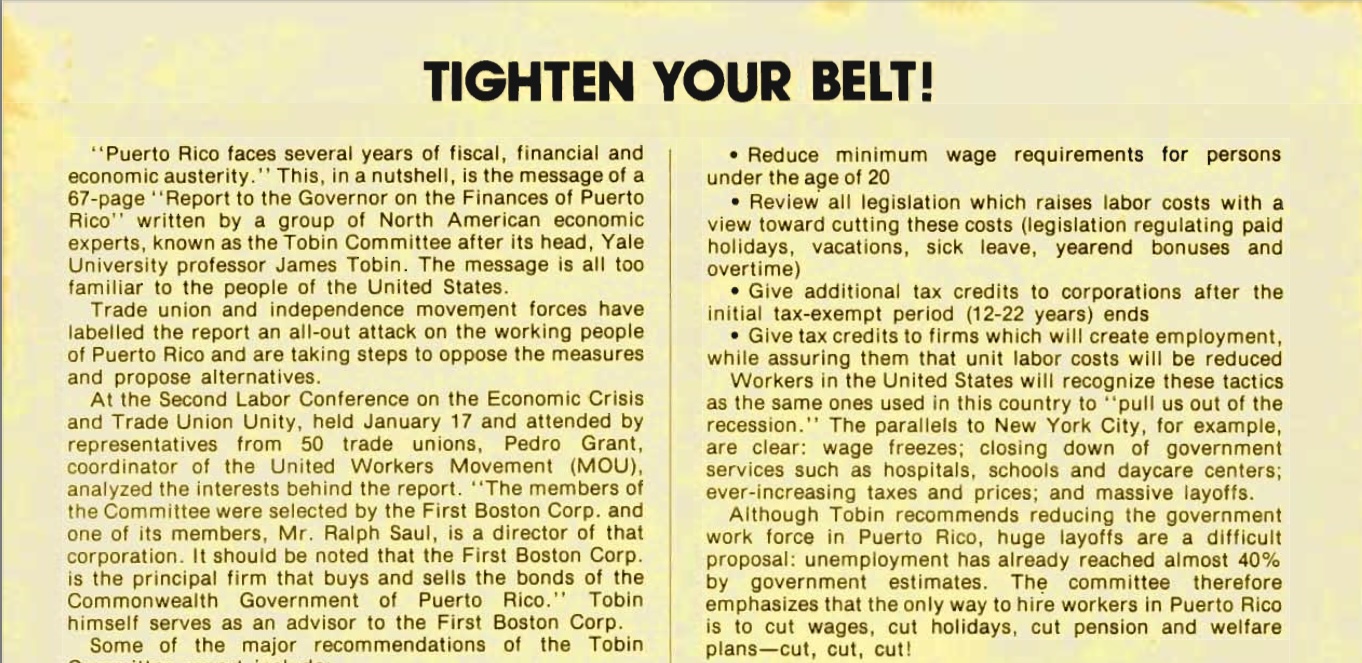
Others see the report as an oppressive colonial scheme. “Tighten Your Belt,” a 1975 article from Claridad, said, “Although Tobin recommends reducing the government work force in Puerto Rico, huge layoffs are a difficult proposal: unemployment has already reached almost 40% by government estimates. The committee therefore emphasizes that the only way to hire workers in Puerto Rico is to cut wages, cut holidays, cut pension and welfare plans—cut, cut, cut! Austerity for whom?”
While views of the Tobin Report vary and its recommendations were not implemented in Puerto Rico, its tenets have been part of discussions of the Island’s economy over the years. In 1993, a report from the Senate Finance Committee titled “Puerto Rican Statehood: A Precondition to Sound Economic Growth” referenced the Tobin Report in its bibliography. The Senate Finance Committee said, “Any implementing legislation for statehood should satisfy four central conditions:
- the transition period should be specifically designed to achieve U.S. budget neutrality;
- section 936 should be phased out quickly, but with due deference to those companies whose investment policies relied on the tax credit;
- the phase-in of full funding for federal entitlement programs should occur simultaneously with the introduction of full federal tax responsibilities on the island; and
- the federal government should provide a “statehood grant” in the form of a trust fund for economic development, but this trust fund should not be used to subsidize the operations of the already oversized Puerto Rico public sector.”
Section 936 has already been phased out, but all four points mesh with the views of the Tobin Report.
The Senate Finance Committee was correct in its understanding that statehood is a necessary precondition for sound economic growth in Puerto Rico. The Tobin Report never discussed this fact.
No responses yet