

The current water crisis in Puerto Rico is a drought, with water rationing in San Juan and other towns affecting about 180,000 customers. The Carraízo reservoir has fallen to critical levels, and parts of San Juan have been without running water for as much as 120 days. While both Flint, Michigan, and Jackson, Mississippi, experienced unsafe or unstable water supplies for months, no other part of the United States has been without running water for so long. What’s causing the water crisis in Puerto Rico?
Drought
67.8% of Puerto Rico is currently experiencing drought. Puerto Rico has seasonal droughts spells, with dry and rainy seasons on a predictable basis. However, the drought is not the only factor in the current water crisis.
Infrastructure
Puerto Rico has just one water company: PRASA, or the Puerto Rico Aqueduct and Sewer Authority. It is responsible for water services throughout the Island, providing about 97% of all drinking water for the territory. The facilities have been inadequate for many years
In 2017, before Hurricane Maria, half the water was lost in transit before arriving at the homes and businesses of customers. 70% of the water had illegally high levels of bacterial contamination at that time, as well as unacceptable levels of lead. San Juan was cited as the city with the lowest water quality in the nation.
Part of the problem was a lack of transparency on the past of PRASA. They had been announcing infrastructure upgrades but had not actually made them. They did not conduct water quality tests on the required schedule, and when they did test, they repeatedly failed. They also lost their EPA funding because they were not following requirements or paying back money borrowed for improvements. Funding for management was an ongoing problem.
With the water authority in such bad shape, the hurricane naturally created an emergency situation. The lack of electricity crippled the water treatment plant and made it impossible for residents to follow the boil order requirements. There were deaths from leptospirosis.
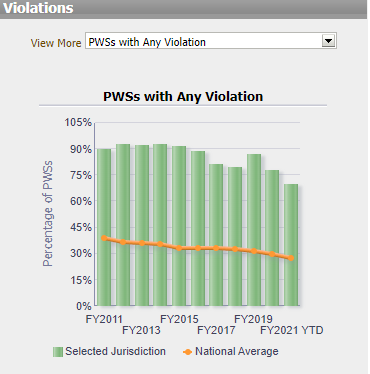
In 2022, the CDC reported that Puerto Rico’s drinking water was generally safe — however, this claim was based on the fact that Puerto Rico is required to meet U.S. water standards, just like the states. Unfortunately, while the situation had improved since the worst years with over 90% of districts in violation of safe water standards, more than two thirds were still in violation.
A citizen commission charged that the PROMESA Fiscal Oversight and Management Board had prevented PRASA from making the needed repairs by throttling their funds. “For the past 10 years, the board has suspended and removed millions in local funds from PRASA’s capital improvement program,” a spokesman told the San Juan Daily Star. “They insisted reconstruction investments should come from federal post‑disaster funds. They also ordered rate hikes, staff reductions, and pushed public‑private partnership projects. Now the country is living with the consequences of those bad decisions.”
There are questions about the amount of restoration PRASA was able to complete with FEMA funds, though. By August 2024, PRASA had reported 113 completed FEMA-funded projects totaling about $58 million. They also reported 131 projects in reconstruction, with obligations still exceeding $1.4 billion—meaning that major work was underway but not finished.
Over the past year, there have been three major ruptures in pipelines. There have also been breakdowns at filtration plants and pumping stations. The infrastructure is clearly not adequate for current needs under normal conditions. In a drought, it cannot provide water for the residents.
“Access to drinking water is not a privilege, a convenience or a luxury; it is an essential service and an inescapable, non-delegable responsibility of the state,” San Juan Mayor Miguel Romero said in a recent hearing, according to The Washington Post.
Territory status
States also face drought: California, Arizona, and Texas have all faced water rationing and drought conditions. However, Puerto Rico does not have the resources to handle drought.
With poorly maintained infrastructure, long-term service issues, and years of austerity measures, Puerto Rico is in no condition to deal with limited water. mIt’s easy to blame the territory’s government or the PROMESA Board, but the problem is more basic.
As a territory, Puerto Rico does not have the economic or political strength to deal with water shortages before they become a water crisis. In states, local and state authorities make decisions and take action in droughts. But Congress also takes action. Laws like the 2019 Colorado River Drought Contingency Plan and the proposed DROUGHT Act of 2026 are designed to help with funding and support. Federal agencies oversee and help local agencies and utilities.
Congress could also provide help for Puerto Rico’s water crisis, but with no senators and no voting members of Congress, Puerto Rico is in a weak position when it comes to federal support. Puerto Rico is also in a relatively weak position economically. While Puerto Rico is prosperous compared with neighboring nations, territory status puts Puerto Rico in a poor economic position compared with the states.
As a state, Puerto Rico would be able to grow economically, have greater say in congressional decisions, and be in a better position to upgrade and maintain infrastructure. Let your legislators know that it is time to end the current colonial relationship and admit Puerto Rico as a state.
No responses yet