

PRInforma, a community news organization, recently posted on its Facebook page, “Troublesome: 70% of Puerto Ricans in the island between the ages of 18-24 have experienced homelessness at some point in the last 10 years.” That would indeed be troubling. But is it true? PRInforma did not share its source, but the question inspired us to learn more about homelessness in Puerto Rico.
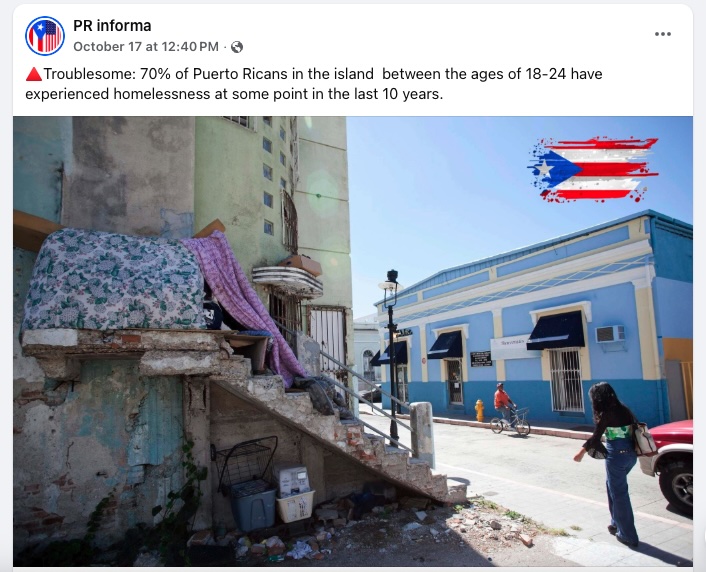
Current homelessness data in Puerto Rico
The “2024 Homeless People Count in Puerto Rico” report from the PR-502 and PR-503 Continuum of Care data, as reported in the San Juan Daily Star, shows 2,096 unhoused individuals on the Island, a drop since 2022. That’s roughly .07% of the total population.
Among the 2,096 people counted, 67% were between 25 and 64 years old, and 14% were over 65 years old. That leaves a maximum of 19% between 18 and 24 — but probably far fewer, since children under 18 make up about 22% of the homeless population of the U.S. overall.
We can feel confident that 70% of 18 to 24 year olds in Puerto Rico are not currently homeless, but that was not the original claim.
Homelessness in Puerto Rico over the past decade
The number of unhoused people in Puerto Rico in 2015 was estimated by HUD at about 3,100 people. With the total population at the time standing at about 3.5 million, this would come to about .09% — a higher percentage than current numbers show.
According to HUD and housing data from World Population Review, and the 2024 Annual Homelessness Assessment Report (AHAR), the U.S. national homelessness rate in 2024 was 22.7 people per 10,000—affecting 771,480 people nationwide. Puerto Rico’s rate, based on its 2024 Continuum of Care count of 2,096 persons, corresponds to roughly 6.4 per 10,000 residents, far below the national average and most states.
Can both these things be true?
Actually, they can. The AHAR and Homeless People Count may be using a different definition of the word “homelessness” from PRInforma and they are certainly using a different methodology and timeframe.
Official counts are based on counting all visibly unhoused people on a single night. These are people sleeping on a sidewalk, in a park. in a car or an abandoned building, or in an emergency shelter or transitional shelter. These counts don’t include people sleeping on a friend’s sofa or in a motel, or families doubling up with other family members, such as a woman and her children moving in with her brother and his family till they get on their feet again. People who are in unstable housing situations are not unsheltered, but they may well feel homeless.
The PRInforma number sounds like a survey of personal experience, asking individuals whether they have experienced homelessness at any time in the past ten years. Some people are being asked to remember back to their childhoods and possibly each person may have their own determination of what constitutes housing insecurity. People in that age group are surely remembering the aftermath of Hurricane Maria. In fact, that period was a fairly large percentage of their lifetimes and having no place to live even for a relatively short time after the hurricane could loom large in their memories.
Why does Puerto Rico have a lower percentage of unhoused people than most states?
Is it because being a territory is a better position, economically, than being a state? Obviously not. Puerto Rico’s poverty rate is higher than that of every state. However, lower rental prices correlate with lower homelessness rates, and the Island has generally had lower rents than most states. Mississippi, one of the poorest states in the Union, also has one of the lowest rates of homelessness…and one of the lowest average housing costs.
In Puerto Rico, cultural traditions may make doubling up with friends and family more common and more acceptable. Also, crucially, people who feel economically desperate in Puerto Rico can move to a state for better opportunities. People in such positions in a state may end up unhoused instead of seeking greener pastures.
No responses yet