

One of the arguments people sometimes use against statehood for Puerto Rico is that the U.S. just doesn’t want Puerto Rico. “Either your efforts have been lackluster in achieving it,” a commenter said about statehood, “or the congress members plainly don’t want you.”
Never mind the possible lack of luster, we should consider the familiar claim that Congress just doesn’t want us.
This commenter went on to say, “No matter how many average americans are sympathizing with statehood or letting us go, it’s the congress and the elites who have the final say.” It is certainly true that Congress is the only group in America that gets to admit new states. it’s also true that about 2/3 of average Americans have favored statehood for Puerto Rico since Gallup began asking them in the 1960s. And yet here we are, still not a state.
How do territories become states?
32 former territories are now states. How did they do it? As our comprehensive reporting on this subject shows, the routes territories took varied enormously. California found gold. Arkansas took advantage of Florida‘s internal squabbles to pip them at the post. Vermont threatened to realign itself with Britain.
Some states were admitted in order to increase the chances of one party’s winning the presidency in the next election and some in order to avoid the end of slavery. Some were admitted almost unanimously, showing great favor in Congress, and some barely squeaked in with just a few votes over the 51% required for admission.
Some achieved admittance fairly quickly once they asked for it, but others spent decades striving for statehood. Puerto Rico has been a territory longer than any other territory, but we imagine that Utah and Hawaii were both ready to give up after a few decades of trying.

They didn’t. And they were admitted. In fact, Congress has never yet permanently refused to admit any territory which has requested statehood.
Is Congress more negative about Puerto Rico than about other territories?
Not by any means. Congress was nasty about many territories before they became states. Arizona was considered “a worthless desert.” Alaska was called “a frozen waste.” Colorado’s population was described as “a roving horde of unsettled adventurers.” Hawaii struggled against a claim that their leaders were communists. Utah allowed polygamy, which was called “barbarous.” Congress has never felt that they had to be polite about U.S. territories.
But Congress has never agreed to make Puerto Rico independent, though there have been several bills calling for independence. These bills naturally did not have the support of Puerto Rico. However, if Congress really wanted to get rid of the Island, they have had multiple chances to do so.
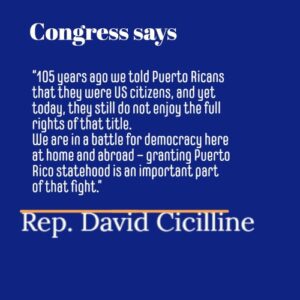
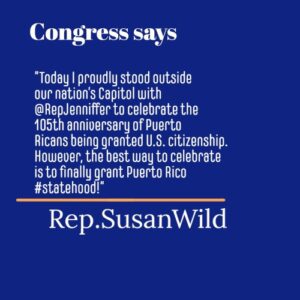
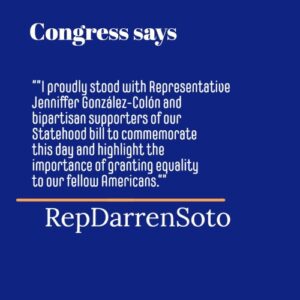
Beyond that, many members of Congress from both parties have supported statehood for Puerto Rico. In fact, the Puerto Rico Status Act passed the House in 2022. The Act required Congress to be willing to admit Puerto Rico as a state if the voters of the Island chose this political status, as they have in every status vote in this century.

Is the U.S. better off with Puerto Rico as a territory?
The United States needs Puerto Rico as a matter of national security, so Congress is not likely to force independence on the Island. But could it be that having Puerto Rico as a territory is a better deal for the United States than having a 51st state?
While there used to be apparently serious claims that a 51st state would require 51 stars on the flag and that would be hard to accomplish, modern technology makes it easy to design a 51-star flag. And though some Republicans have admitted that they don’t want to allow Puerto Rico a full voice in Democracy because they don’t believe that their party can appeal to voters there, many different parties have been in power since Puerto Rico became a territory, and none of them have yet admitted Puerto Rico.
The strongest argument in favor of keeping Puerto Rico in the current territorial status is that Congress is allowed to treat territories differently from states. When Puerto Rico is a state, the U.S. will have to pony up the full amount of federal funding for programs like Medicare and SNAP. This argument, like the very fact that we still have a colony in the 21st century, is an embarrassment to the United States. But it’s also not as strong an argument as it may initially seem, because a state of Puerto Rico would doubtless be more prosperous than the territory — this has been true for every territory which has become a state so far, and ma ny were in worse positions than Puerto Rico when they joined the Union. A prosperous state will bring more into the federal coffers than an impoverished territory.
With little representation in Congress, Puerto Rico is not a priority for either the House or the Senate. We must make it clear that we need to be a priority. Reach out to your representatives today to remind them that Puerto Rico should have statehood.
No responses yet